Show Jumping Course Design and Horse Welfare: Fair Questions, Not Traps
·
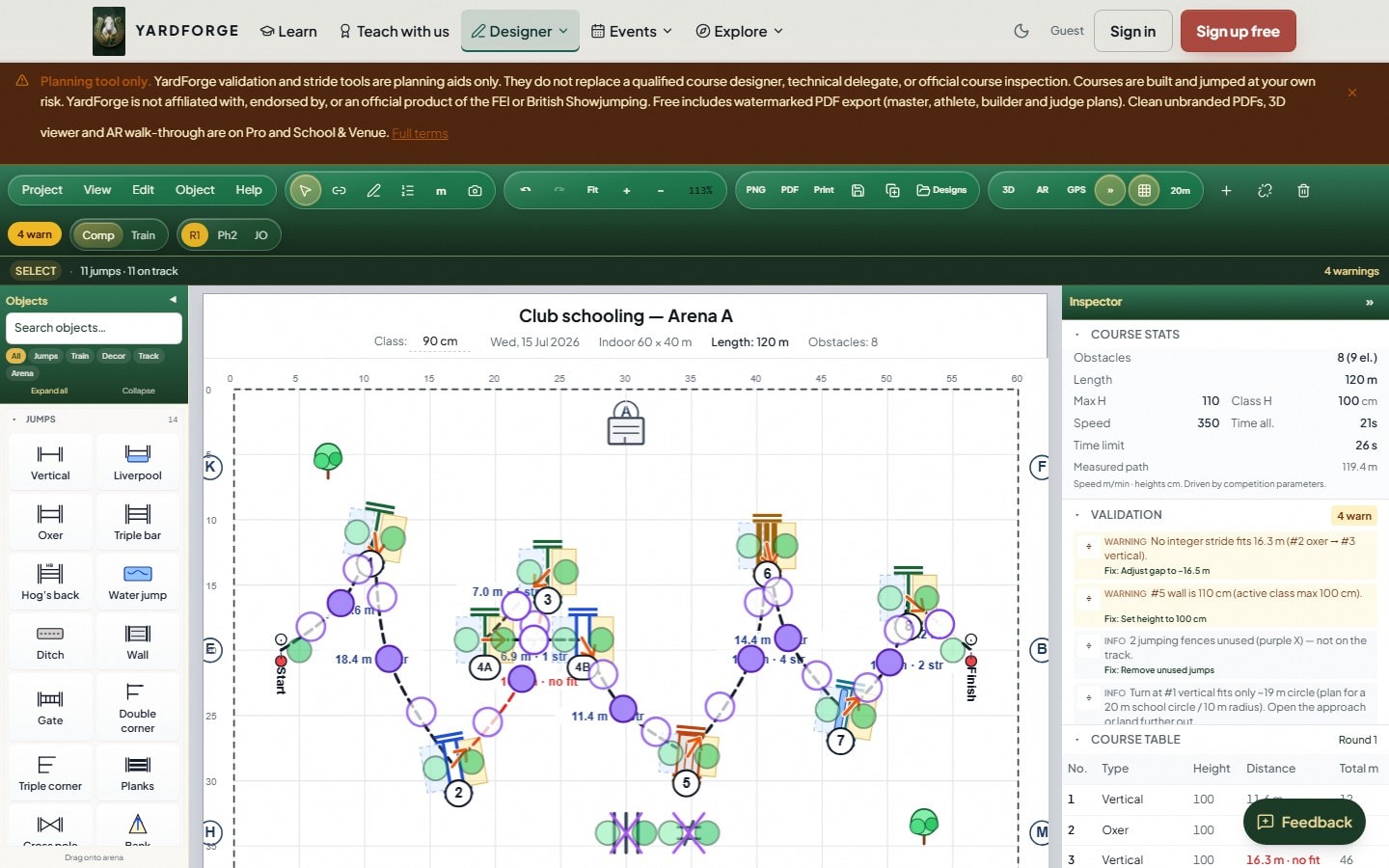
Horse welfare sits at the centre of equestrian sport’s social licence in 2026. Riders at the top of the sport increasingly talk about long-term careers for their horses; national campaigns stress health essentials; and every club designer still chooses whether a track asks a question or sets a trap. This article is for people who design and build show jumping courses, from unaffiliated evenings to affiliated classes, and want the plan to ride fairly.
It is not a substitute for FEI or British Showjumping rules, or for the official course designer’s sign-off at championship level.
Why welfare and design are the same conversation
A welfare-minded course:
- Matches the level of the class (height, width, related distances)
- Progresses difficulty so the hardest question is not fence one
- Leaves space to rebalance after combinations and sharp turns
- Avoids optical tricks that only punish honest horses
- Can be walked, built and ridden with the same map
When public trust is thin, “clever” tracks that regularly produce unnecessary falls or refusals cost the whole sport, not just one entry fee.
Design principles that protect horses
1. Set the standard before the first wing
Choose FEI, BS, Hunter or Unaffiliated first, then design. Switching standards mid-plan is how illegal spreads and combination distances sneak in. Use FEI vs British Showjumping validation and, for 2026 schedules, FEI Jumping Rules notes for designers.
2. Design the line the horse rides
Fences hang on a track. Long approaches, fair turns and readable lines produce better jumping than packing the ring. See how to design a show jumping course and bending lines.
3. Related distances are a welfare issue
A short combination for the level is not “educational”, it is a risk. Measure, validate, and check ponies separately. The stride calculator and distances guide exist for this.
4. Combinations and water need extra honesty
Combinations multiply mistakes. Water and Liverpools need a clear approach and an exit that does not fire the horse into a wall. Read understanding combination fences and Liverpool and water tips.
5. Jump-offs should still be rideable
A jump-off that only rewards recklessness fails the welfare test. Keep options and fair turns, how to design a jump-off.
Warm-up and the course you never drew
Welfare fails in the collecting ring as often as in the main arena:
- Enough space and poles for the class size
- Clear warm-up etiquette posted
- Shorter warm-ups in heat, heat stress guide
- Sensible warm-up routines
Building what you designed
A beautiful plan that cannot be built accurately still hurts horses. Number fences clearly (how to number a course), export a builder plan from the designer, and walk the track after the build, not only on the tablet.
Social licence: what clubs can publish
Without inventing statistics, clubs can show process:
- “Courses validated against BS / FEI tables before print”
- “Builder and athlete plans issued from the same design file”
- “Heat policy and biosecurity note with entries”, see biosecurity checklist
Transparency is part of welfare culture.
How software helps (and where it does not)
Digital course design helps you:
- Keep true-to-scale arenas and distances
- Catch illegal heights/spreads early
- Share read-only plans so fewer people “adjust” poles by eye
- Walk the flow at ground level before poles move
It does not replace walking the track, knowing your horses, or following the official rulebook. Use tools like YardForge’s course design software as a precision layer, not an autopilot.
Practical welfare checklist for designers
- [ ] Standard set (FEI / BS / other) before fence one
- [ ] Progressive difficulty
- [ ] Combinations legal and fair for the level
- [ ] No unnecessary traps at the gate or wall
- [ ] Jump-off still rideable
- [ ] Plan exported for builder and athletes
- [ ] Track walked after build
Bottom line
Fair questions make better sport. In 2026, that is a competitive standard and a welfare standard. Design the line, respect the distances, validate the rules, and walk what you built.
Open the free course designer and build a track you would be happy to ride on a green horse, then raise the questions only as the class level allows.
Related: How to walk a course · BS course-building rules · Polework for show jumpers · Best course design software UK
Design tools: Free show jumping course designer · Course design software · UK course design guide · Open the designer

