How to Number a Show Jumping Course
·
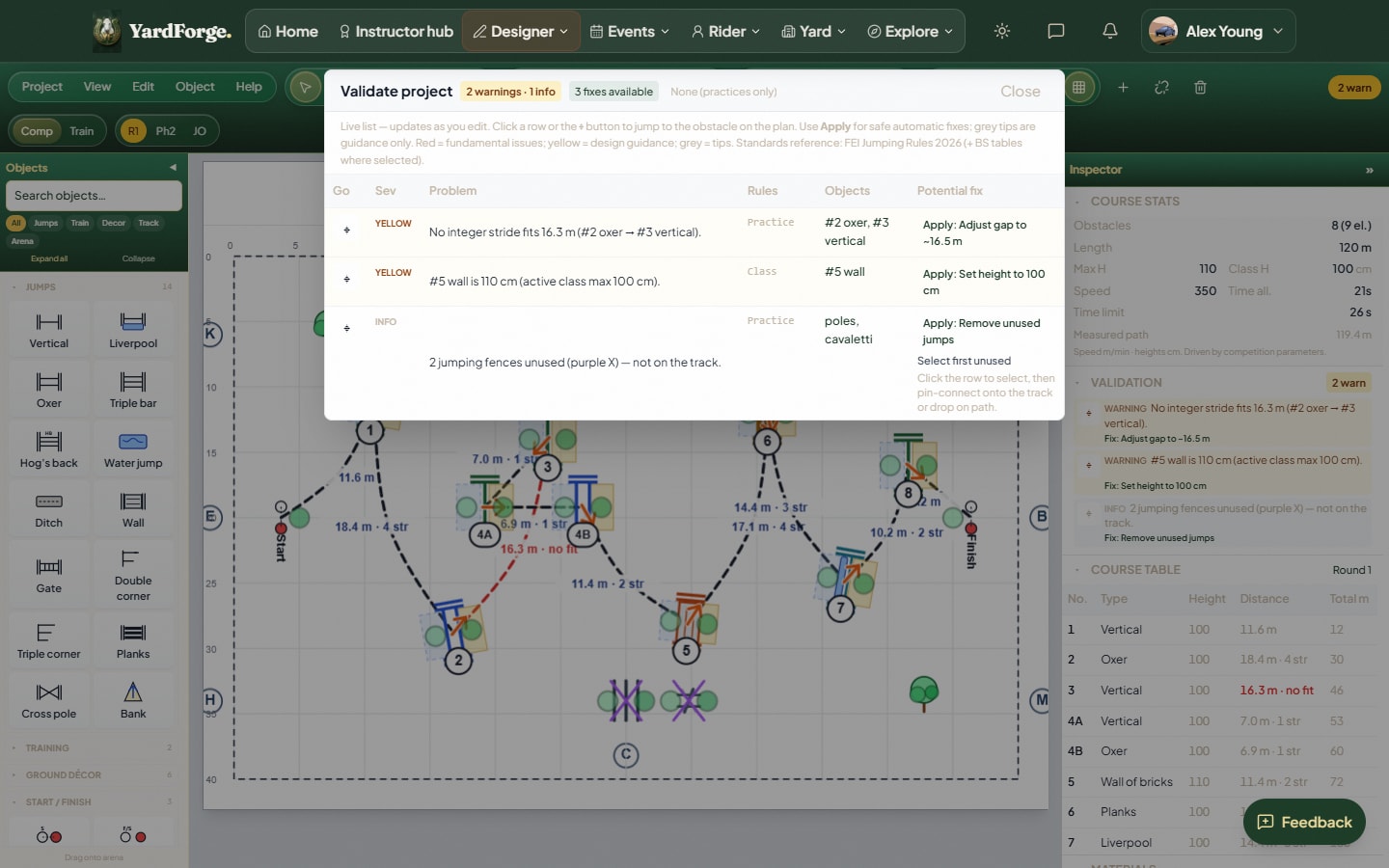
Numbering looks trivial — fence 1, fence 2, fence 3 — until you are standing in the arena with twelve obstacles and a track that has to cross itself twice without confusing the rider. Done well, the numbers tell a clear story the horse can read at a canter. Done badly, they create blind turns and impossible lines.
Numbers define the track, not the other way round
A common mistake is to place fences first and number them afterwards by proximity. Strong design works the other way: decide the line the horse rides, then number along it. The numbering is the track. See our full guide to designing a show jumping course for how the line comes first.
The rules of the road
- Sequential and visible — each number must be reachable on a rideable line from the one before it.
- Combinations share a number — a double is
7Aand7B; a treble is7A,7B,7C. They are one obstacle with elements, not three separate fences. - Start and finish — the timing line is crossed once at the start and once at the finish; do not let the track clip it mid-round.
- No accidental crossings — where the track crosses itself, the numbers and flags must make the correct fence obvious at speed.
Four numbering strategies
When you number digitally, the course designer can apply a strategy in one click and you adjust from there:
- Nearest — follow the shortest sensible hop from each fence to the next. Good for flowing tracks.
- Clockwise — work the fences in a consistent rotation around the arena.
- Compact — keep the track tight for small arenas or indoor schools.
- Reverse — renumber from the finish back, useful when you redesign the closing line.
Combination-aware numbering handles the 5A/5B labelling for you, so elements never get separate whole numbers by mistake.
Check it by walking it
Numbers that look logical from above can still ride badly. Walk the course in 3D or AR, look from fence to fence, and confirm every transition gives the horse time to see the next obstacle. Then walk it physically as the rider will.
The short version
Number along the line the horse rides, keep combinations as lettered elements of one number, and never let the track cross itself ambiguously. Get that right and the course reads itself.
Related: How to design a show jumping course · Understanding combination fences · Show jumping course design software

