How to Design a Jump-Off Course That's Fast, Fair and Safe
·
The jump-off is the part of the class spectators remember, and the part of the plan many builders leave until the first round is already standing. Designed well, a jump-off rewards brave, balanced riding and produces a genuine race. Designed badly, it rewards flat gallop, punishes careful horses, and ends with rails everywhere. Here's how to design it on purpose.
Design the jump-off with the first round, not after it
The classic mistake is building a lovely first round, then discovering the only possible jump-off is a dull loop. Work the other way: sketch both rounds together, and let the jump-off drive where key fences sit. You're looking for first-round fences that, with two or three of their neighbours removed, suddenly offer inside turn options, the gap left by a skipped fence is exactly where the brave rider will turn.
A reliable recipe for a six-to-eight fence jump-off from a ten-to-twelve fence first round:
- Keep the first fence simple, riders arrive with adrenaline; give them one inviting effort to establish canter.
- Alternate turns, left-handed then right-handed, so one-sided horses don't get a free run.
- Include one genuine option, a line where the inside track saves a second but risks a pole, and the steady outside track is always available. Our bending lines guide covers building two-track questions that are fair both ways.
- Finish towards the exit, a last line running away from the collecting ring rides sticky and punishes honest horses late on the clock.
Numbering the second round
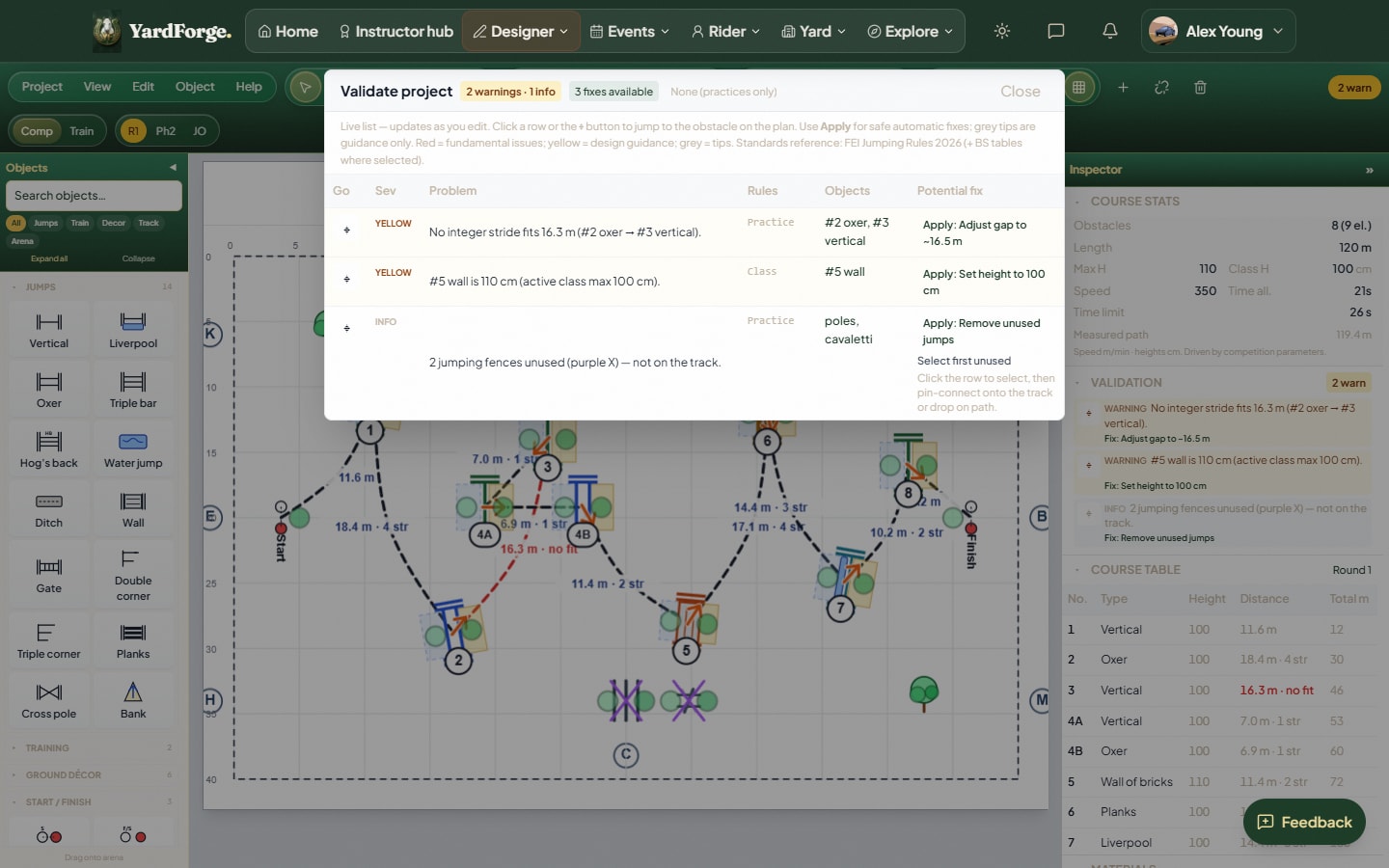
Fences shared between rounds keep their first-round numbers; the convention is a second set of number cloths (often a different colour) for the jump-off sequence. If your class runs under FEI-style numbering, added fences take numbers following on from the first round. Our course numbering guide covers the conventions in detail, and if you build in the YardForge designer, each round carries its own path, so you can flip between Round 1 and the jump-off and see exactly which fences each track uses, with the distances re-measured for the shortened route.
Heights, spreads and the time allowed
- Raise selectively, not everywhere. Most rule books allow the jump-off to go up in height and/or spread. Raising two or three fences keeps the question sharp without turning a speed round into a puissance.
- Never raise the fence before the tightest turn. The horse arrives flatter and faster in a jump-off; the rail you added there mostly measures luck.
- Set the time allowed off the shortened track. Measure the jump-off route as it will actually be ridden, around the turns, not fence-centre to fence-centre, and apply the class speed. A time allowed set off the straight-line distance is unbeatable without cutting every corner flat.
Check the turns are actually rideable
Every jump-off invites tighter turns than the first round, that's the point, but there's a floor. A horse in a jumping canter needs real room to turn and re-balance before a fence; a "shortcut" that requires a ten-metre-radius U-turn to a maximum oxer isn't an option, it's an ambush. When you bend the jump-off track in the designer, the turn checker validates each arc against stride length and flags turns that don't fit, before the first horse tells you louder.
A jump-off checklist
- Both rounds designed together, jump-off turns falling where skipped fences leave gaps
- First jump-off fence inviting; turns alternate left and right
- At least one genuine inside/outside option, fair both ways
- Raised fences chosen deliberately; nothing raised before the tightest turn
- Time allowed measured along the real ridden track
- Both rounds validated for distances and turns at the class height
Do that, and the class ends the way good sport should: decided by riding, in front of a crowd that saw every second of it.

