Show Jumping Distances UK: Related Distances & Walk Metres
·
Walk into any collecting ring and you'll hear riders muttering numbers — "it's a quiet two", "the double's a forward one". They're talking about related distances: the gap between fences measured in your horse's canter strides. Get them right and the line rides; get them wrong and you're fighting for every fence.
How distances work, the standard metres to walk for horses, and how going changes the ride.
What is a related distance?
A related distance is any line where the gap between two fences is short enough that the number of strides is fixed — usually anything up to about seven or eight strides. Beyond that, the horse has room to adjust and it's no longer "related".
The two that matter most are:
- Combinations — fences set one or two strides apart, jumped as a unit and numbered together (7A, 7B, 7C).
- Related lines — two separate fences on a set distance, usually three to seven strides apart.
The standard distances to walk
These are the everyday numbers for a horse with an average 3.5m canter stride, measured centre to centre:
| Strides | Typical question | Metres to walk |
|---|---|---|
| Bounce (no stride) | Bounce | 3.3m–3.7m |
| 1 | Double | 7.0m–7.7m |
| 2 | Double or related | 10.0m–11.0m |
| 3 | Related line | 14m–15m |
| 4 | Related line | 17m–18m |
A useful rule of thumb: allow roughly 6m for take-off and landing across a pair of fences, then 3.5m per canter stride in between. So a clean two-stride works out around 6 + 2 × 3.5 ≈ 13m of jumping effort, which on the ground sits near 10.5–11m between the fences.
The exact number depends on the horse, the fence height and the going — these are starting points, not laws.
Pony relateds sit shorter than this horse table. For 128 / 138 / 148 classes use the British Showjumping pony distances guide, or check the stride calculator.
Footing changes everything
Deep or holding ground shortens a horse's stride, so distances ride longer than the tape says. Firm ground does the opposite. A wet, holding arena can turn a textbook two-stride into a real push. In YardForge you can set going and ground slope so the stride numbers match the day, not only the diagram.
Let the tool do the maths
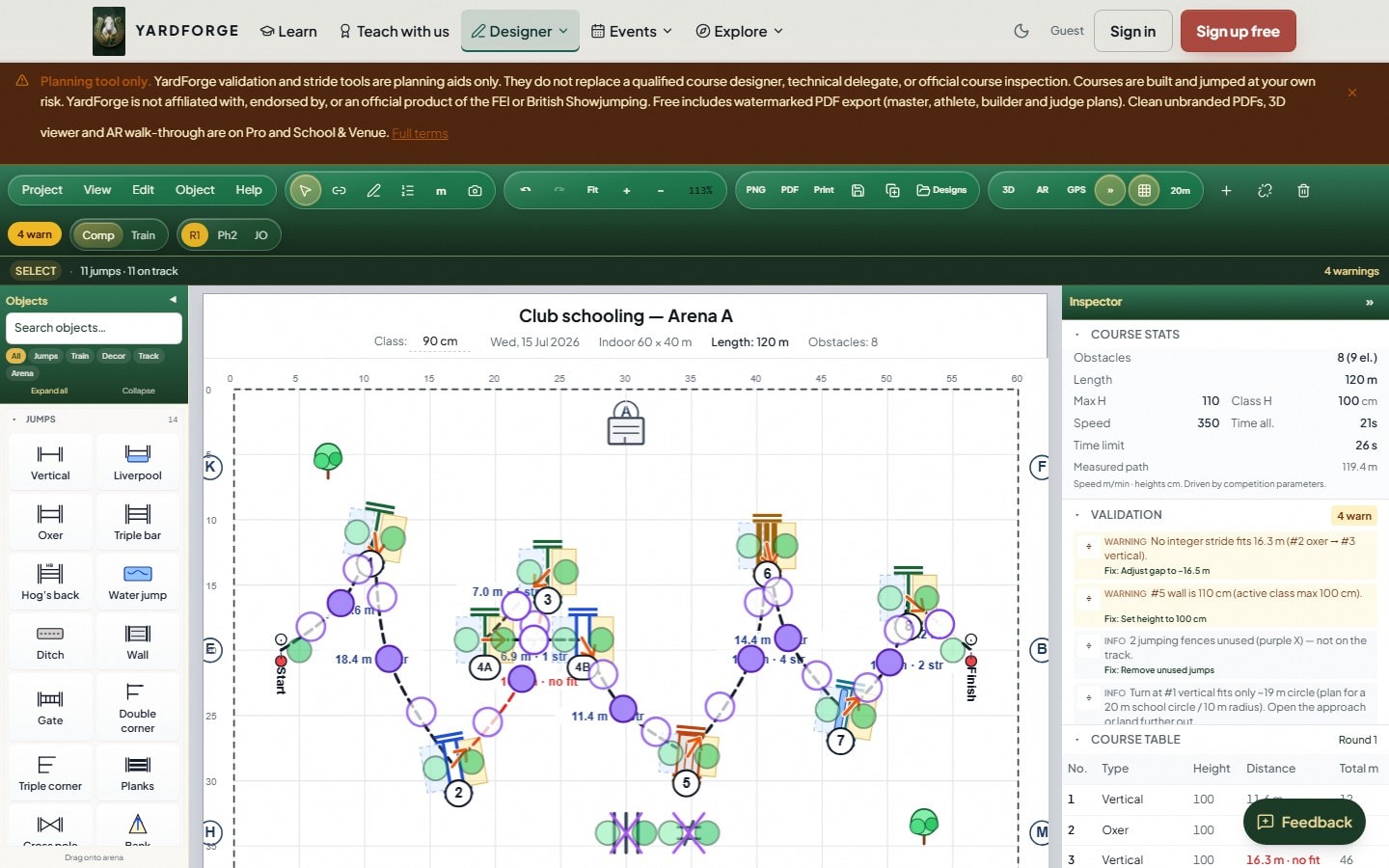
You don't have to memorise the tables. Lay fences in the course designer, set your horse, and you get distance and stride count on every line live — plus flags for British Showjumping or FEI, with a one-tap fix when you want it. Single distance only? Use the stride calculator or take the free stride chart.
Walk it, ride it, adjust it.
Design tools: British Showjumping course design software · Free show jumping course designer · Course design software · UK course design guide · Stride calculator · Free stride chart · Open the designer

