Understanding Combination Fences in Show Jumping
·
A combination is two or more fences with one or two strides between them (occasionally a bounce). Riders who walk them badly pay at element two.
Stride mechanics
The horse needs take-off room before fence A, landing room after each element, and enough straight line to see the next fence. Designers measure inside the line the horse actually rides.
Typical canter stride: 3.5–3.7 m for a large horse; ponies subtract 0.3–0.5 m.
Walking combinations
- Stand at the centre of fence A — look through to B.
- Count strides aloud at walk pace (one human stride ≈ 1 m for quick estimates).
- Note whether the line is uphill, downhill, or to a blind turn after the combination.
Riding choices
- Bounce: sit light, hands following; no kicking mid-air.
- One stride: land and re-balance before asking for the next take-off.
- Two stride: often the forgiving option for amateur classes — still ride the second stride actively.
Design perspective
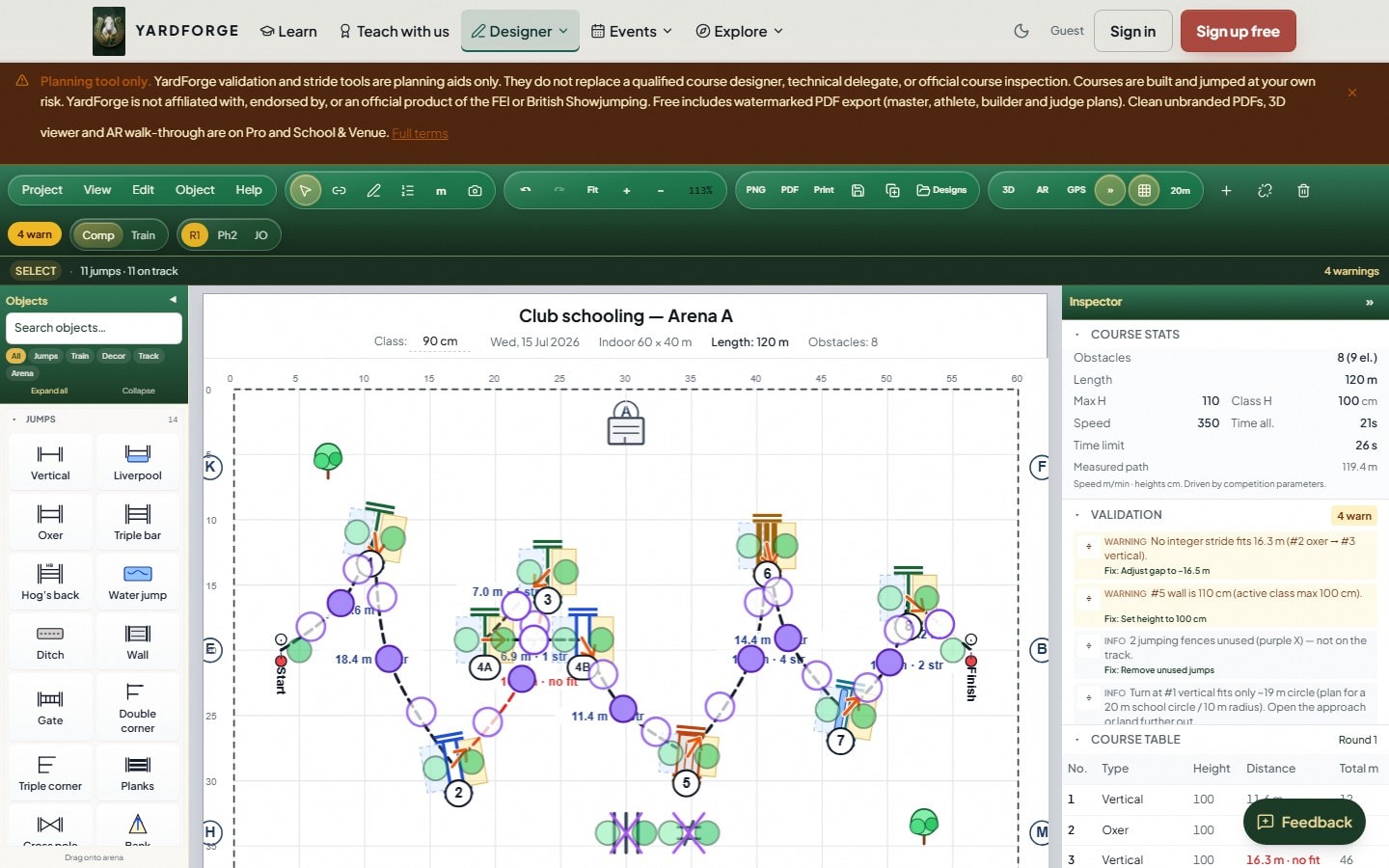
If you build combinations, validate each internal distance against your rule set in show jumping course design software before you commit. A combination that works on paper but points at a wall is a trap, not a test.
Walk combinations twice. The second pass is where you commit to the plan your horse will execute.
Related: How to design a show jumping course · Show jumping distances explained · Use the stride calculator
The distances to walk
Between elements of a combination, on an average horse stride:
- Bounce (0 strides): 3.3–3.8m — gymnastic exercise territory; rare in the ring below top level.
- One stride: 7.0–7.7m — the everyday double.
- Two strides: 10.0–11.0m — common in trebles as the second gap.
Element heights matter: a one-stride from a vertical into an oxer usually walks slightly shorter than oxer-to-vertical, because horses land steeper over a square oxer. Ponies need every gap shortened — our distances guide has the full pony adjustments.
How combinations are scored
A refusal at any element means re-jumping the whole combination — that is what makes them expensive. Under BS and FEI rules, a stop at B after a clean A still sends you back to take A again, with the clock running. Poles down are scored per element: knock A and B and you carry eight faults, not four.
Designing fair combinations
If you build your own courses, three rules keep a double honest:
- Straightness first. The line through both elements should be dead straight and square to each fence face.
- True distances. Use the published tables, then check them against your actual horses in the designer — its validation flags combination distances that are outside the legal band for your class, and can auto-fix them.
- Ask once. One hard question per combination: a big oxer out of a short one-stride and a spooky filler is two questions stacked — save one for elsewhere on course.

