FEI Jumping Rules 2026: Schedule Changes Course Designers Need to Catch
·
On 1 January 2026 the FEI Jumping Rules entered force as a full revision, the 28th edition. For riders the headlines are safety cups, tack transitions and warm-up arena phone bans. For course designers and show organisers the bigger story is quieter but more operational: a restructured rule book, championships folded into the Jumping Rules, and article numbers that no longer match last season’s schedule templates.
This article is a designer-facing briefing, not a full rule commentary. Always check the official FEI Jumping Rules 2026 PDF and the changes summary before you sign a plan.
Why 2026 is a big rules year
The FEI periodically runs a full rules revision. In 2025 the Jumping Rules were rewritten and modernised, then approved by the General Assembly. The package that landed for 2026 includes:
- A restructured rule book, easier to navigate, but every schedule and software template that hard-coded old article numbers needs a pass.
- Championships integrated into the Jumping Rules, Continental and World Championship frameworks live in Chapters XII–XIII rather than floating in separate instruments.
- Youth alignment, Children and Pony Championship formats were grouped and, importantly for designers of youth finals, judging tables (e.g. Table C vs Table A for some championships) may differ from what you used last year.
If you only update fence heights and ignore article renumbering, your schedule can be non-compliant even when your track is excellent.
Article renumbering: the schedule trap
Organisers and CDs already report that familiar competition articles have moved. Community notes (and national federation chatter) flag renumbers such as older Art. 238 / 273-style references shifting into the new 220-series numbering for common competition formats.
Practical checklist for every FEI schedule you touch in 2026:
| Check | Why it matters for design |
|---|---|
| Competition article on the schedule matches JR 2026 | Jump-off rules, phases and “against the clock” options drive how you shape the track |
| Jump-off option stated clearly | Equality of penalties → jump-off format changes how hard you build the first round |
| % / number returning for a second phase or winning round | Multi-phase designs must match what the schedule allows |
| Time allowed / speed | Your measured track length still has to support a fair TA for the stated speed |
In software, set FEI as the standard before you place fences so validation and export labels match the class you are building, see our FEI vs British Showjumping validation guide.
What still drives the design of the track
Rule renumbering does not replace craft. The same fundamentals that decide rails still decide rails:
Related distances and combinations
Combinations (one- and two-stride questions) and related distances remain the core technical language of the sport. Design them on a measured line, not by eye:
- Use a stride calculator tied to the horse profile for the class.
- Prefer pole-to-pole (jumping) distance when you are building for rails, not the long way around a decorative path.
- Check bending lines separately, a six-stride on a curve is not a six-stride on a straight.
Arena size and indoor vs outdoor
FEI arena dimensions and floors still constrain turn radius and gallop. Outdoor 40×60 designs ride differently from indoor short rings, open lines vs compact rollback questions. Your software should lock the real surface before you invent a track.
Jump-off design
When the schedule allows a jump-off against the clock, design a second question set that shortens without becoming a lottery. See how to design a jump-off course.
Championships and youth: design implications
Folding championships into the Jumping Rules is meant to give one coherent framework. For designers that means:
- Read the championship chapter that applies (seniors vs youth / veterans) before you build, formats are no longer “tribal knowledge” buried elsewhere.
- Children and Pony Championships may use different judging tables than senior Table A norms. Your design should still be fair for the division; your schedule language must match the 2026 text.
- Team and individual formats affect whether you need a single track for all or progressive day-to-day questions.
If you build multi-class weekends, group plans under course print packs so each class’s PDF cover and article metadata stay consistent.
Safety equipment note (builders and CDs)
Builders and CDs should stay aligned with FEI safety-cup depth and approved equipment lists. Community discussion has highlighted shallower FEI safety cup requirements in recent cycles (e.g. max depth discussions around 18 mm). Confirm the current equipment annexes rather than relying on older cups in the park.
Tack and artificial-aid rules are moving toward standalone instruments with transitional periods, less about fence placement, more about what walks into your warm-up. Know what the show is enforcing so your warm-up exercise design does not fight the stewards.
How digital design helps under the 2026 book
Pen-and-paper still works. Software that is FEI-aware saves the expensive mistakes:
- Standard + level first, heights, spreads and effort limits clamped before you invent a line.
- Live validation, combination tables and distance warnings while you drag, not after poles are up.
- Measured free-track path, the ridden line (and pole-to-pole leg numbers) match what you print on the master plan PDF.
- Role exports, athlete, builder and judge sheets from one course file for championship crews.
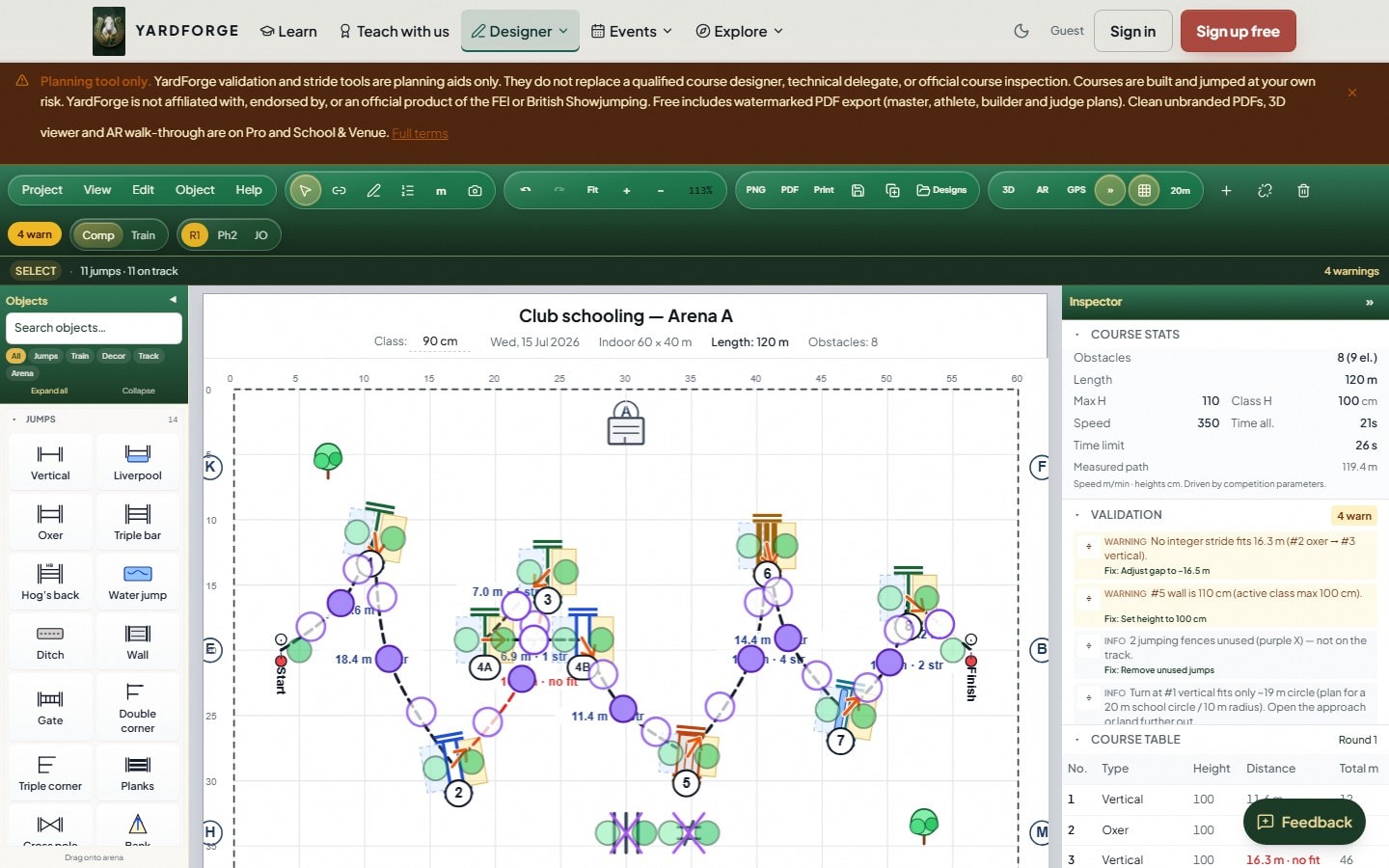
Try a full workflow in the YardForge course designer or compare options in our UK course design software guide.
Quick 2026 CD checklist
- Download the official JR 2026 PDF and the FEI changes page, do not design from a 2024 bookmark.
- Update every schedule article number for competitions you write.
- Confirm jump-off / phase options before drawing fence 1.
- Set arena size, entry/exit and standard in software before placing.
- Validate related distances and combinations; export the course as a PDF.
- Walk the line (or open 3D from a shared course link) before the first horse.
FAQs
Do FEI Jumping Rules 2026 change combination distances?
The craft of combination design is unchanged: you still set fair one- and two-stride questions for the height and division. What did change is the organisation of the rule book, championship chapters and many article numbers, so always verify the competition format article on the schedule against JR 2026.
Where do I find the official 2026 Jumping Rules?
On the FEI site: the full Jumping Rules 2026 PDF and the Jumping Rules, Changes for 2026 summary.
Does YardForge validate against FEI 2026 article numbers?
YardForge validates design parameters (heights, spreads, combination tables, effort limits) against FEI / BS standards in the designer. Schedule article numbers on entry forms remain the organiser’s responsibility, use the official FEI PDF when writing schedules.

