Jumping Arena Size in Feet: A Practical Conversion Guide
·
In short: FEI outdoor competition rings need at least 4,000 m² and a 50 m short side, which a 50 × 80 m (164 × 262 ft) ring meets. A 40 × 60 m club ring is about 131 × 197 ft and a 20 × 40 m school about 66 × 131 ft. Multiply metres by 3.281 for feet.
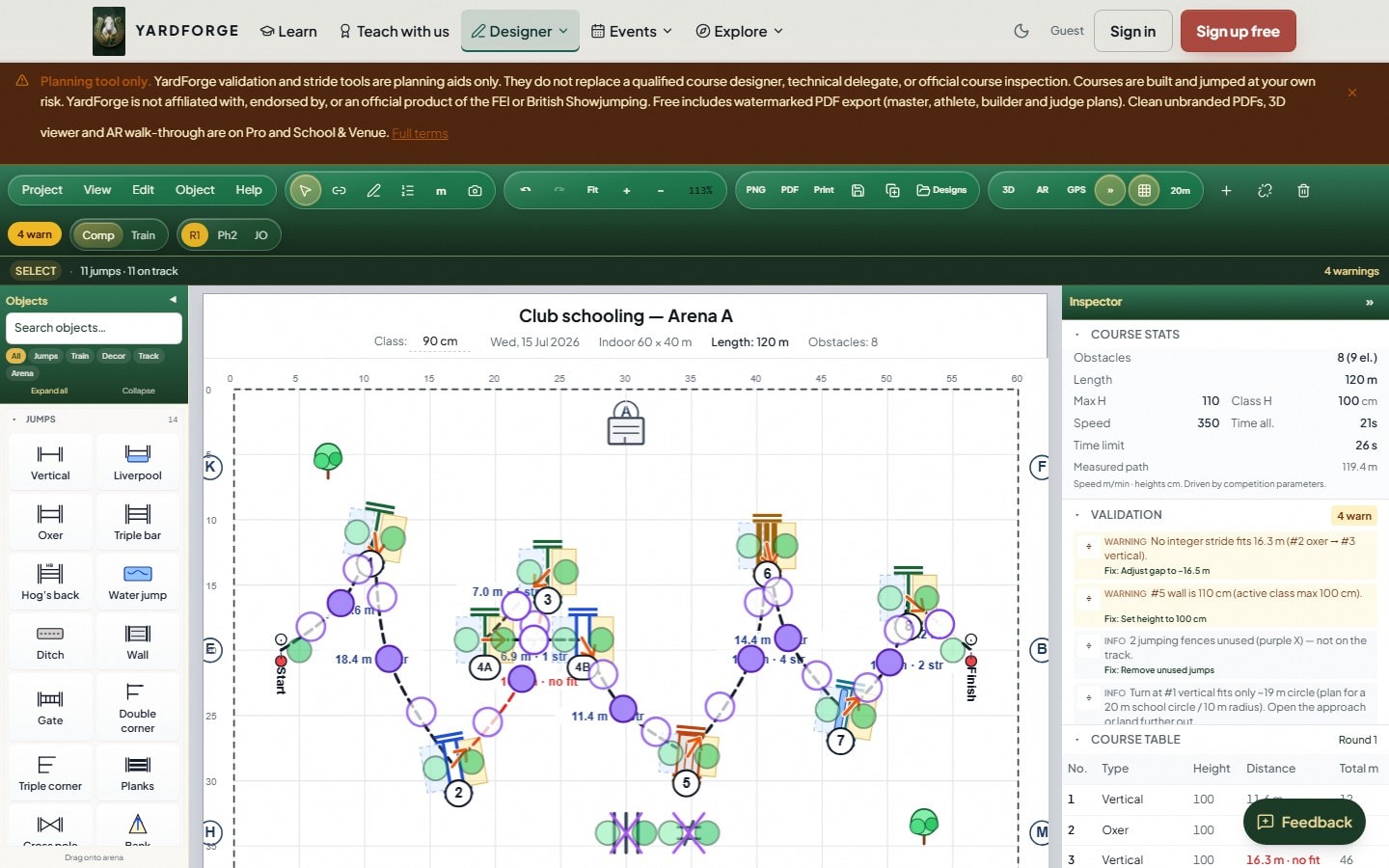
Course design rules are written in metres, but plenty of riders, builders and yard owners still think, and measure, in feet. If you have ever stood at the fence line trying to picture a competition ring in a unit that actually means something to you, this is the conversion you need.
Quick answer
FEI outdoor competition rings are checked by area and short side (≥ 4,000 m², short side ≥ 50 m), roughly a 164 × 262 ft (50 × 80 m) footprint as a practical example, not a hard “only size”. A 40 × 60 m club ring is about 131 × 197 ft and is below that FEI outdoor minimum. A typical UK schooling arena at 20 m × 40 m works out to about 66 ft × 131 ft. Indoor arenas are frequently smaller, a common indoor size of 20 m × 60 m converts to 66 ft × 197 ft.
Metres to feet: arena size conversion table
| Arena (metres) | Arena (feet) | Typical use |
|---|---|---|
| 20 × 40 m | 66 × 131 ft | Small schooling arena, riding club |
| 20 × 60 m | 66 × 197 ft | Indoor school, many livery yards |
| 30 × 60 m | 98 × 197 ft | Larger outdoor schooling arena |
| 40 × 60 m | 131 × 197 ft | Common club outdoor, not FEI outdoor min |
| 50 × 70 m | 164 × 230 ft | Larger outdoor competition footprint |
| 50 × 80 m | 164 × 262 ft | Meets 4,000 m² / ≥50 m short side outdoor rule of thumb |
| 60 × 80 m | 197 × 262 ft | Championship / Nations Cup–scale arena |
One metre is 3.281 feet, so any arena you measure or find quoted in metres converts by multiplying both width and length by 3.281. A 20 m round pen, for example, comes out at just under 66 ft across.
Why feet still matter even in a metric sport
FEI and British Showjumping rules are metric, and our FEI arena dimensions guide covers the official minimums in metres. But arena size in feet still matters day to day:
- US and some international riders think in feet by default, especially when comparing a home arena to a competition footprint.
- Older UK arenas were sometimes built to imperial dimensions (a 60 ft × 120 ft manège is a classic example) and never remeasured in metric.
- Fence and equipment manufacturers in some markets still quote wing spacing and rail lengths in feet.
- Quick mental maths at the yard, "is this arena big enough for a related distance?" is often easier in a unit you already use for stride length or paddock size.
Converting your own arena
If you know your arena in feet, divide both dimensions by 3.281 to get metres before checking them against a rule book, course design standards and stride calculators on this site work in metres. A 100 ft × 200 ft arena, for instance, is close to 30 m × 61 m: long enough in one direction for many related distances, but short of the FEI outdoor short-side (≥ 50 m) and area (≥ 4,000 m²) checks.
Don't guess, measure or map it
Converting a number on paper is only useful if the number is accurate. Rather than pacing out an arena in "feet" that are really just steps, use GPS to measure the real footprint, see our guide to GPS arena mapping by walking the perimeter. The GPS arena mapper in YardForge fits a rectangle to your walked track and reports both metric and derived dimensions, so you always know exactly what footprint you are designing into.
Arena size and course design
Whichever unit you think in, the arena footprint sets hard limits on what a course can contain, related distances need straight approaches, combinations need landing room, and water or liverpool fences need a real approach run. Our arena dimensions guide walks through how those limits shape design decisions once you know your real footprint in metres.
Related: FEI arena dimensions guide · GPS arena mapping for course design · How to design a show jumping course

