Bending Lines in Show Jumping: Distances, Strides and How to Design Them
·
A straight related distance asks one question: can you hold a rhythm? A bending line asks two: can you hold a rhythm and choose a track? That second question is why designers love them and why they decide more classes than any oxer, a bending line gives every rider a slightly different distance, and the rider who commits to a plan wins the line.
What makes a line "bending"
Two fences are on a bending line when the natural track between them is a curve rather than a straight lane, usually because the second fence is offset to one side, or the arena wall forces an arc. The distance you walk on the ground depends entirely on which arc you ride:
- The inside track is the shortest line, fewer metres, so fewer strides, but a sharper turn that costs balance.
- The outside track adds metres, an extra stride ridden on a gentler curve, easier to balance but slower against the clock.
A six-stride bending line on the direct track often walks as a genuine seven on the outside. Neither is wrong. What's wrong is not deciding.
Walking a bending line
Walk the track you actually intend to ride, not the straight line between the fences, a straight-line measurement of a curved track is fiction. Start at the centre of the first fence, walk your intended arc, and finish square to the centre of the second. Walk it twice: once on the inside line, once on the outside, and note both stride counts. Now you have a plan A and a plan B before you ever canter.
Our course walking checklist covers pacing technique; the short version is that four of your walking steps ≈ one horse stride, and on a curve you must walk the curve.
Riding it
- Land with a plan. The line is decided in the air over the first fence, land looking at your chosen track, not at the second fence.
- Ride the arc, not the fence. Pick a point on the curve (a letter, a filler, a chalk mark in your mind) and ride to it. The fence arrives on its own.
- Keep the rhythm, adjust the track. On a bending line, professionals adjust the curve to fix a distance rather than the canter. Wider arc = longer distance = the quiet extra stride; tighter arc = shorter = the forward option.
Designing fair bending lines
If you build courses, bending lines are your best tool for separating rhythm-riders from passengers, but they have to be fair:
- Both tracks must work. Design the line so the inside and outside options both arrive on a rideable distance. If only one track fits a whole number of strides, you've built a trap, not a question.
- Square both fence faces to their own track. Each fence should face the arc as it arrives, not the straight chord between the fences.
- Respect the turn radius. A 90cm class can handle a tighter arc than a 1.40m class, but no horse turns on a five-metre radius out of a jumping canter. Give the curve room.
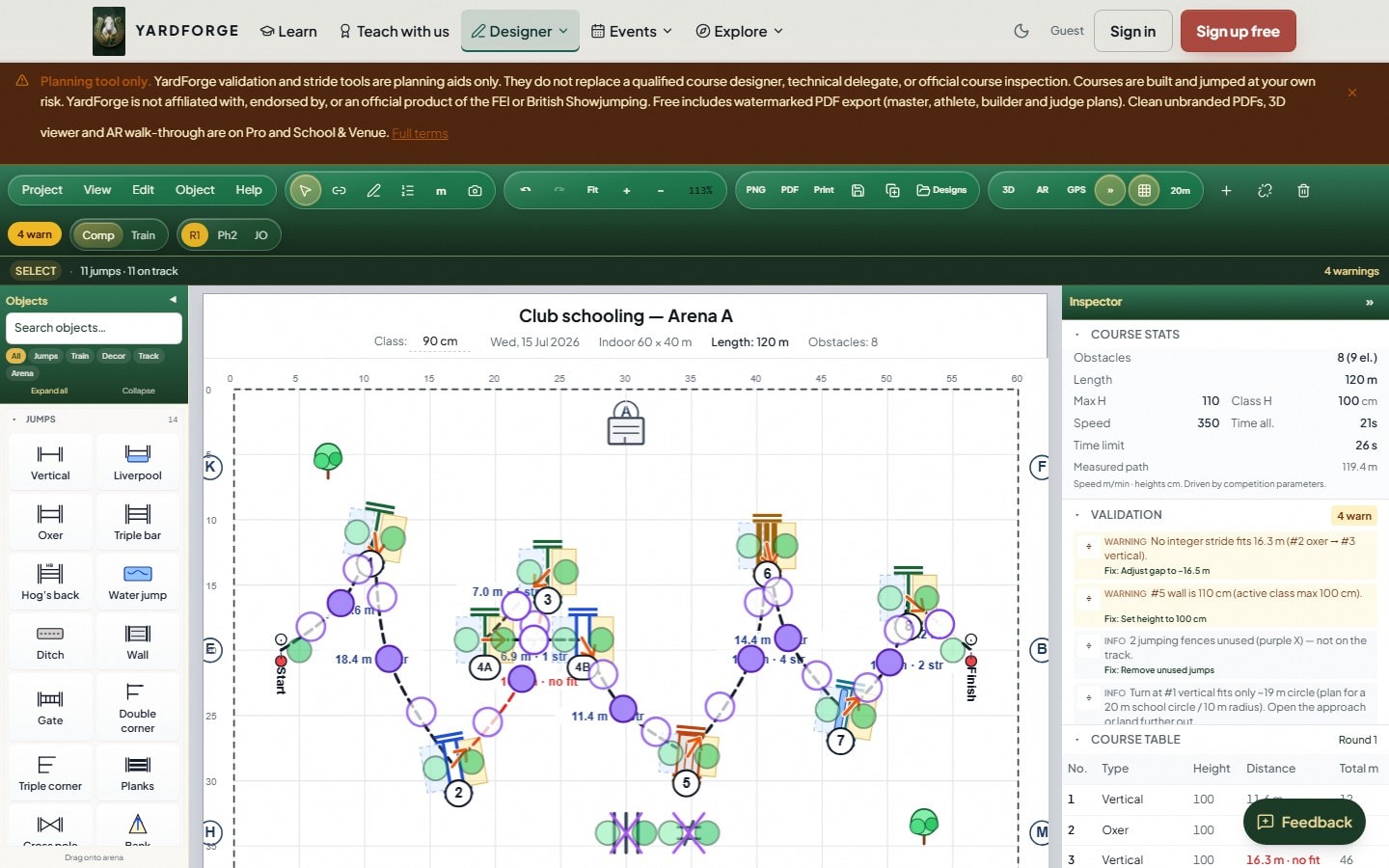
In the YardForge designer, drag the path handle on any connection sideways to bend the ridden line, the stride count and distance recalculate live along the curved track, not the straight chord, and the turn is checked against your horse's actual stride and turning arc. If the bend you've drawn is too tight for the level, the validator flags it before a rider finds out the hard way. It's the same maths behind our related distances guide, applied to the arc.
The jump-off connection
Almost every jump-off is decided on bending lines, leaving out a stride on the curve is the classic way to win five metres without galloping faster. If you're designing a class with a jump-off, read our companion guide on designing a jump-off course: the trick is to build first-round bending lines that become the shortcut options in round two.
Bend the line, keep the rhythm, and let the track do the arithmetic.

