Show jumping faults and penalty points explained (plain English)
If you are a parent watching a first unaffiliated night, or a rider reading the scoreboard for the first time, the numbers can look mysterious. This page explains what you usually see at UK club, riding-club and clear-round nights, in plain English.
Rules vary by show. Always check that day's schedule and ask the judge or show secretary if anything is unclear. This is not an official federation guide and it is not endorsed by British Showjumping, Show Jumping Ireland, the FEI, or any other governing body. Affiliated handbooks and club documents can disagree with each other on detail. Treat what follows as a reading guide for the board, not a rulebook.
Faults vs "points" (clear the confusion)
Two different ideas get mixed up in conversation.
Round faults (sometimes called penalty points for the round) are what the scribe adds up for that trip around the course: rails, refusals, and sometimes time. Fewer faults is better. A clear round means no jumping faults (and inside the time, if that class uses one).
League or grading "points" are a separate idea. They usually come from placings, double clears, or a series table across several evenings. A winter league may award league points for a win or a clear. That is not the same number you see for one knockdown on the live board.
This page sticks to round faults at club nights. It does not invent British Showjumping or SJI grading tables. If you are running a multi-round series, how to run a winter show jumping league covers planning without pretending to publish an official points scale.
Knockdowns
At most club and clear-round nights, a knockdown means a fence (or part of a fence) falls because of the horse or rider. The judge decides whether it counts. Shows add faults for each counted knockdown, but the exact total is set by that night's schedule or the table the organiser has chosen to follow. Club nights are not a universal standard, so this page stays number-free: look at the schedule, watch how the board updates after a rail, and ask the judge if you are unsure. One rail is rarely the end of the class on its own at a friendly clear-round night, but the show's own rules decide.
Refusals and run-outs
A refusal is when the horse stops in front of a fence. A run-out is when the horse ducks past the wing instead of jumping. Both usually count as a disobedience under the day's rules.
What happens next depends on the class:
- A first refusal is often scored with faults and the rider is allowed another attempt at that fence, if the class format allows it.
- A further refusal can mean more faults, or it can mean elimination from that class. Club sources and affiliated club documents do not always line up on the second-refusal detail, so do not treat a social-media graphic as gospel.
- "Elimination" in plain terms often means you are out of that class for the placing. You may still be asked to leave the arena safely. Ask the judge what applies tonight.
Check the schedule for how refusals are scored tonight. Ask ringside if the board looks wrong.
Time faults and time limits
Not every club night uses the same clock rules.
Some classes set a time allowed. If you finish over that time, the scribe may add time faults on top of any jumping faults. How those time faults are calculated belongs in that show's rules (or in the affiliated table the organiser has chosen to follow). We are not inventing speeds or seconds here.
Other club formats use a simpler time limit: finish inside it or you are out, with no gradual time faults. Clear-round evenings sometimes skip timing altogether and only care about jumping faults.
If the board shows a time next to a score, that class is using a clock. If there is no time column, ask whether the class is untimed or whether timing starts later (for example in a jump-off).
What "clear round" means
A clear round means the horse and rider finished with no jumping faults. If the class also uses a time allowed, clear usually means no jumping faults and inside that time.
Two common formats:
- Clear-round classes. Everyone who goes clear gets a clear-round ribbon, rosette, or mark on the card. Placings may not matter. The point is the clear.
- Classes that place on faults then time. Clears share the top band; the fastest clear wins if there is a jump-off, or the clock separates them in a single round, depending on the schedule.
Home and club clear-round tracks are a good place to practise reading the board. If you are building one in a home arena, design a home-arena clear-round show jumping course walks through the layout side.
How a live results board shows it
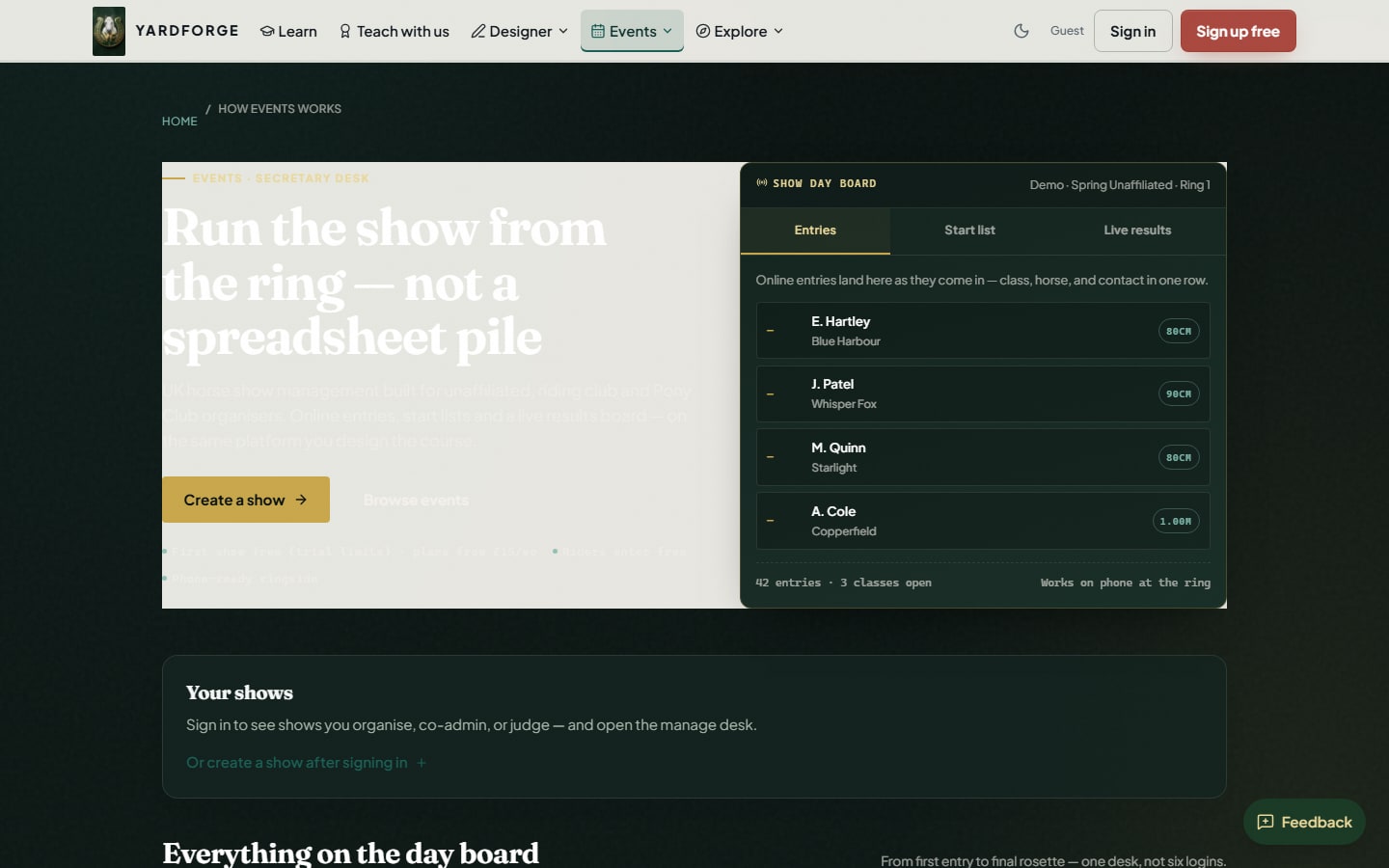
On many YardForge club nights the scribe scores ringside and the live results board updates for spectators on their phones. The board shows rider and horse, Faults, Time when the class uses a clock, Status (for example Pending, Clear, Faults, E, RET, or W/D for eliminated, retired, withdrawn, or similar), and a jump-off column when that class uses one. This page does not invent scoring rules the product does not use, and it does not claim the board applies FEI or British Showjumping tables.
On public results, junior names redact to first name and initial by default, so a full child's name is not broadcast unless the class settings allow a public name. That keeps the board useful for parents without turning every junior class into a public directory.
Organisers set this up from show organiser. Free during beta.
Finding or running a club night
If you want to watch or enter, browse open fixtures on events. If you run the night yourself, take entries and results on show organiser so the start list and the board share one class list. Free during beta; riders enter free.
For a winter series of club evenings, see how to run a winter show jumping league. For building a friendly clear-round track, see the home-arena clear-round course guide.
Check that day's rules
Read the schedule. Ask the judge. Do not treat this page (or any social graphic) as a substitute for the rules that apply in that arena tonight. YardForge does not claim to follow, replace, or endorse British Showjumping, SJI, FEI, or any other federation table.
This page stays number-free on purpose: it is a plain reading guide, not a federation table.