Run a Winter Show Jumping League: UK Club Guide
A winter show jumping league is a points series run over several club shows through the winter, usually from September or October into the spring. To run one, fix the dates and venues first, then set height classes, a simple points table and a rule for horse–rider combinations. Publish results after every round and keep the course plans on file.
The rest of this guide covers the detail that stops a league ending in a row at the prize-giving.
In this guide
- What a winter league is
- Winter league timeline
- Classes and heights
- Points systems
- Horse and rider names
- Planning courses across the series
- Entries, start lists and results
- Weather and cancelled rounds
- Winter league checklist
- FAQ
What a winter show jumping league is
A league links separate shows into one competition. Each round stands on its own, and riders collect points towards a table that's settled at the end of the season. Pony Club Area leagues make good models:
| Format | How it works | Real example |
|---|---|---|
| Area or branch individual league | Members are entered automatically when they jump a qualifying class. Points go to each horse and rider combination, with a champion per height. | Area 6 (1 Oct 2026 to 30 Apr 2027) and Area 12 (1 Oct 2026 to 30 Apr 2027) |
| Inter-branch team league | Branches send teams to a run of shows hosted in turn by different branches, with team and individual tables. | Area 5 ran from September to March in 2025–26, with a £16 entry fee agreed for that season |
| Open unaffiliated series | A venue or club runs its own series open to all, under its own rules. | Many venues run these, and you write the rules yourself |
These are examples, not rules for your club. Write your league rules so they sit alongside the rules of your own Area or affiliated body.
Winter league timeline: 8 weeks out to the final
Work backwards from round one.
- 8 weeks out: fix dates and venues. Book every round, including the final, before anything else.
- 6 weeks out: write the rules document. Cover heights, eligibility, points, tie-breaks, minimum rounds and cancellations, on one page if you can.
- 5 weeks out: agree the officials. Name one person each for builder, judge, entries secretary and league table-keeper.
- 4 weeks out: open entries for round one and publish all the dates.
- Round one: run the show, publish results the same day, and post the first league table within the week.
- Mid-season: review. Check for duplicate horse names and tell riders how many rounds they still need.
- Final: confirm who qualifies, then plan rosettes and the prize-giving.
Winter league classes and heights
Pick height bands for the members you actually have. The Pony Club examples cover quite different ranges:
- Area 12 runs PC40 to PC110.
- Area 6 runs from a 30cm lead rein class up to 100cm and over, and members aren't limited to one class.
- Area 5 ran six classes, from 50cm to PC100, with age limits on the lowest three.
For riding clubs, a useful reference is the British Riding Clubs Horslyx Winter Show Jumping Championships, held at Arena UK on 28–29 March 2026, where classes ran from 60cm to 100cm.
Whatever you choose, write down who is eligible for each class. Say too whether a combination may move up a height mid-season, and whether their points move with them. Settle it now and it won't come up at the final.
Show jumping league points systems that don't cause arguments
A good points system is one a parent can check on the back of a start list. Here are two real systems as examples:
| Area 6 (2026/27) | Area 12 (2026–27) | |
|---|---|---|
| 1st | 10 | 8, plus 1 for taking part |
| 2nd | 8 | 7, plus 1 for taking part |
| 3rd | 6 | 6, plus 1 for taking part |
| Further places | 4th 4, 5th 3, 6th 2 | Down to 1 point for 8th |
| Unplaced | 1 for completing | 1 for taking part |
| Clear rounds | Not scored separately | 2 extra for a double clear |
| Limits | Must compete in 3+ league rounds to appear in the final results | Counts a maximum of 2 classes per combination at each show |
Area 12's table rewards turning up and jumping clear, while Area 6's rewards placings. Whichever suits your members, publish it before round one and leave it alone until the final.
Decide these as well, before round one:
- Tie-breaks. For example, most wins, then best result at the final. Write it down.
- Best rounds or all rounds. Counting a rider's best few rounds is kinder to families who can't make every date. Say how many count.
- Minimum rounds to qualify for the final table, as Area 6 does.
- Small classes. Area 6 awards points whatever the number of entries in a class. If you'd rather not, say so.
- Mixed classes. If non-members jump too, say whether points go by overall placing or by placing among league riders (Area 6 uses the latter).
Horse and rider names: keep them identical
Points follow the horse and rider combination, so the horse's name has to match exactly at every round.
Area 6's rules are clear on this: enter the same name for your horse or pony at every competition, or your points go to each horse name you ride. "Bramble", "Bramble II" and "Brambles" would become three separate entries in the table.
Ask for the passport name on the entry form, and keep a master list of combinations so you catch near-duplicates before results go out.
Planning courses across the series
Course design is a job in its own right, and we've covered it separately in our guide to indoor winter showjumping course design for UK clubs. For the league organiser, two things matter.
First, plan every round's course before the day, so the builder isn't designing in the dark at 7am. Second, keep each plan on file. When someone asks at the final why round three felt harder than round one, you can show them.
Builders change from round to round, and they work in all sorts of ways, from pencil sketches to desktop course-design software that only runs on Windows. Ask for every plan as a PDF or a print-out, and keep them together where anyone on the committee can find them, not on one volunteer's laptop.
Entries, start lists and results
Run entries through one desk, with a single secretary and a single entry list. Entries that arrive by text message or on the back of an envelope are how riders go missing from the start list.
If you're a Pony Club branch, the Pony Club asks branches to use one of its approved online booking systems, or to enter events in PELHAM by hand. The approved systems check membership when someone books and send attendance back to PELHAM, so check which one your branch uses before you open entries.
Our guide to online horse show entries for UK organisers covers setting up entries for a single show. For a league, repeat that for each round and add a column for the league combination.
Post results the same day if you can. Both Area 6 and Area 12 only count results that are published on Pony Club Results.
On junior names, check your organisation's safeguarding and data rules before you publish full names online.
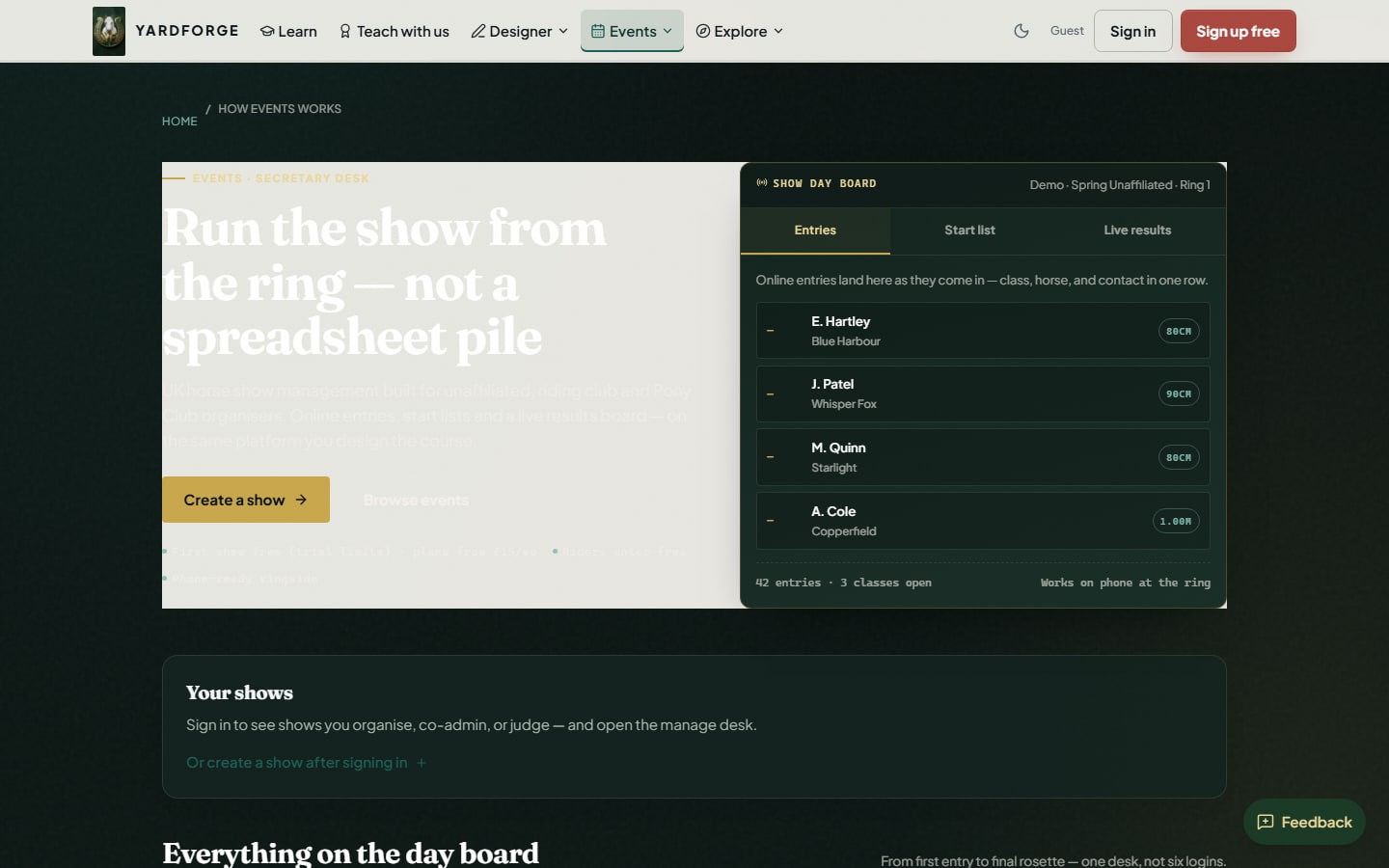
For riding clubs and venues running an open series, the YardForge show organiser keeps online entries, start lists and live results in one place, and shows junior riders as first name and initial by default. For the branch side of things, Pony Club management covers rally and competition scheduling and attendance.
Weather and cancelled rounds
Decide now what happens when a round is cancelled.
- Indoor or outdoor? An indoor venue lowers the weather risk, but icy roads can still stop a show.
- Rearranged or dropped? Say whether a cancelled round is rearranged or simply removed from the season.
- Points. If a round is dropped, the simplest rule is that the league runs over the remaining rounds, and any minimum-rounds rule reduces to match. Write your version down.
- Refunds. Your club sets the refund wording. Put it in the rules document and on every schedule.
Winter league checklist: the season on one page
Print this and pin it up in the secretary's office:
- [ ] All dates and venues booked, including the final
- [ ] Rules document: heights, eligibility, points, tie-breaks, minimum rounds, cancellations, refunds
- [ ] Officials named: builder, judge, entries, table-keeper
- [ ] Entry system chosen (Pony Club branches: an approved booking system)
- [ ] Entry form asks for the horse's registered name
- [ ] Course plan drawn for round one, and saved as a PDF or print-out
- [ ] Results published the same day
- [ ] League table updated within a week of each round
- [ ] Mid-season check for duplicate horse names
- [ ] Qualifiers confirmed before the final
- [ ] Rosettes and prizes ordered
Planning a whole series? Draw each round's track in the free YardForge designer, keep every plan in one place and print copies for the builder and judge. It's free during alpha, and you don't need a card. → Open the designer
FAQ
How many rounds should a winter show jumping league have?
Enough to give riders a fair chance without overloading volunteers. Pony Club Area 6, for example, lists five qualifying dates so far for 2026/27, from October to February. If you count only each rider's best rounds, or set a minimum number of rounds to qualify, families who miss a date can still take part in the table.
How do points work in a show jumping league?
Each round awards points by placing, and the totals decide the table. Some leagues add points for taking part or for clear rounds. Pony Club Area 12, for example, gives 1 point for taking part, 2 for a double clear and 8 to 1 for first to eighth. Publish your table before round one and keep it fixed.
Can a rider enter more than one horse in a winter league?
Usually, yes. Most club leagues score each horse and rider combination separately, so points follow the pairing rather than the rider. Enter the horse under exactly the same name at every round, or the points may be split across two records. Check your own league's rules on how many classes count per show.
What heights should a Pony Club winter league include?
Base it on your members. Area 12 runs PC40 to PC110, while Area 6 starts with a 30cm lead rein class and goes up to 100cm and over. Start with the heights your branch's shows already run, and check eligibility against the current Pony Club rules and your Area's league rules.
What happens to points if a league round is cancelled?
That's up to your league rules, so write it down before the season starts. Common approaches are to rearrange the round, or to run the league over the remaining rounds and reduce any minimum-rounds rule to match. Put the refund wording in the rules too, so nobody has to decide on a frosty morning.

