Frangible Devices and Safer Course Design in 2026: Lessons for Designers
·
Frangible devices, pins, clips and latches designed so a fence fails safely under the wrong kind of impact, are no longer niche XC hardware. Through 2025–2026, federations and media have kept returning to the same story: eventing is looking outward at safety research, approval pathways for new devices, and course design that reduces rotational-fall risk before a pin has to save the day.
Even if you only build show jumping for clubs and indoor arenas, the design habits behind frangible technology transfer: read the horse’s line, avoid unforgiving questions, and treat “activation” as a failure of the plan, not a success of the kit.
What frangible technology is for
In eventing, fixed fences can cause rotational falls when a horse hits hard and the obstacle does not yield. Frangible systems (historically pins; today also MIM clips, adjustable latches and other approved hardware) are engineered so the fence breaks or drops under defined loads, reducing the chance the horse cartwheels.
They are not a licence to build dangerous lines. FEI and national messaging in 2026 still frames devices as one layer alongside:
- Better understanding of how horses read fences
- Smarter distances and profiles
- Education for designers and builders
- Data from activations and falls
If pins fire often on your course, the course is asking the wrong question, or the wrong level.
The 2026 safety conversation in brief
Recent industry coverage has focused on:
- Innovation approval processes so new devices can be evaluated against performance standards rather than blocked by “we only know the old pin.”
- Funding and rollout so grassroots venues, not only five-stars, can install modern hardware.
- Design literacy, workshops for course designers on when a fence should be frangible and how the approach sets up the impact.
Stuart-style designer education and FEI risk-management seminars keep the human skill equal to the metal clip.
Lessons show jumping designers should steal
Show jumping poles fall by design; the welfare risk is different (rails, twisted ankles, loss of confidence, public optics). Still, frangible thinking maps cleanly:
1. Design so “failure hardware” is rarely needed
In SJ: fair related distances, readable turns, progressive difficulty. See course design and horse welfare and related distances.
2. Match the question to the class
A technical triple for a first 90cm class is the SJ cousin of an unforgiving XC corner for novices. Height is not the only difficulty, line and distance are.
3. Prefer visible honesty over optical tricks
False ground lines, deceptive fills and “gotcha” skins punish honest horses and look awful on social video, a social-licence problem as much as a technical one (social licence guide).
4. Measure the line the horse rides
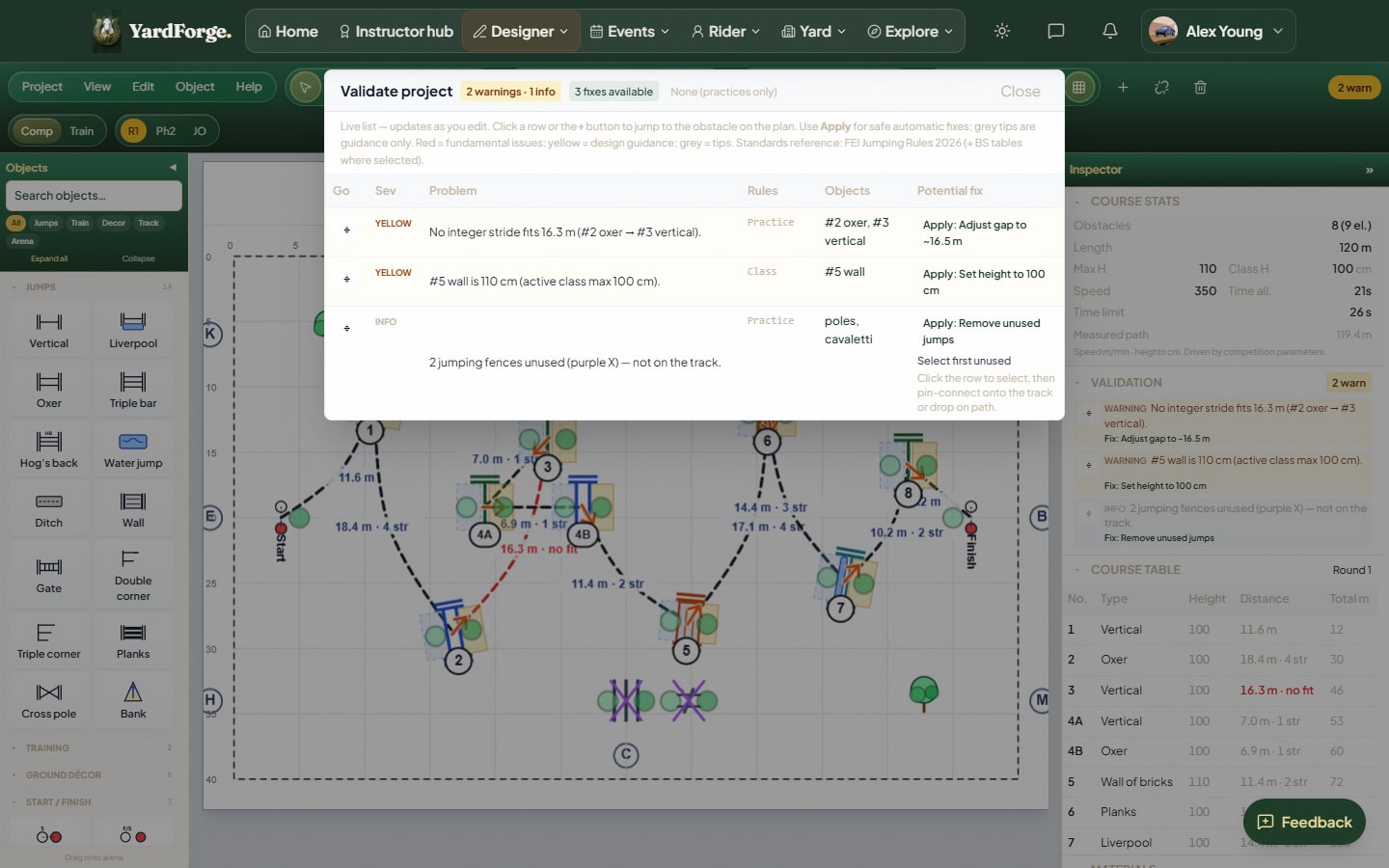
XC and SJ both fail when designers measure centre-to-centre on paper but horses gallop a wider arc. Use real arena dimensions and ridden path length. The stride calculator and plan designer exist to keep distances honest before you put a cup in a hole.
5. Record what happened
Eventing studies activations; SJ clubs should log where rails fall and where stops cluster. Patterns tell you which fence is badly placed for this surface and level.
A practical pre-build checklist (any discipline)
- [ ] Level of class written down before the first fence is placed
- [ ] Opening three fences inviting, not selective
- [ ] Combinations and related distances checked for the standard (FEI / BS / unaffiliated)
- [ ] Turns leave space to rebalance
- [ ] Ground lines consistent with how the horse should jump
- [ ] For XC: approved frangible hardware where the profile demands it; pins not used as decoration
- [ ] Plan printed for builder, judge and rider walk (sample plan PDFs)
- [ ] After the class: note activations, falls, and rail statistics
Builders and designers are one team
Hardware fails when installation is wrong: wrong pin type, wrong orientation, cups that grip when they should release. Treat the builder’s briefing like a safety document, diagram, fence numbers, device type, torque/settings if required. Digital plans reduce “I thought you meant the other oxer” errors; export builder-facing sheets from a single source of truth rather than a napkin sketch.
What not to do
- Do not assume a frangible fence makes a bad line safe.
- Do not chase viral “technical” tracks that regularly produce rotational risk or mass stops.
- Do not ignore national approval lists, unapproved DIY “breakaway” is liability, not innovation.
- Do not skip the walk: if you cannot walk the line smoothly, horses will not jump it smoothly.
Bottom line
In 2026, safer course design is a stack: research-backed hardware, educated designers, fair lines, and honest review after the ribbon is handed out. Frangible devices are a triumph of engineering, but the best course is still the one where the device never has to prove itself. Design the question so good riding is rewarded and honest horses stay on their feet.

