Club Show Course Design Checklist (UK): From Empty Arena to First Horse
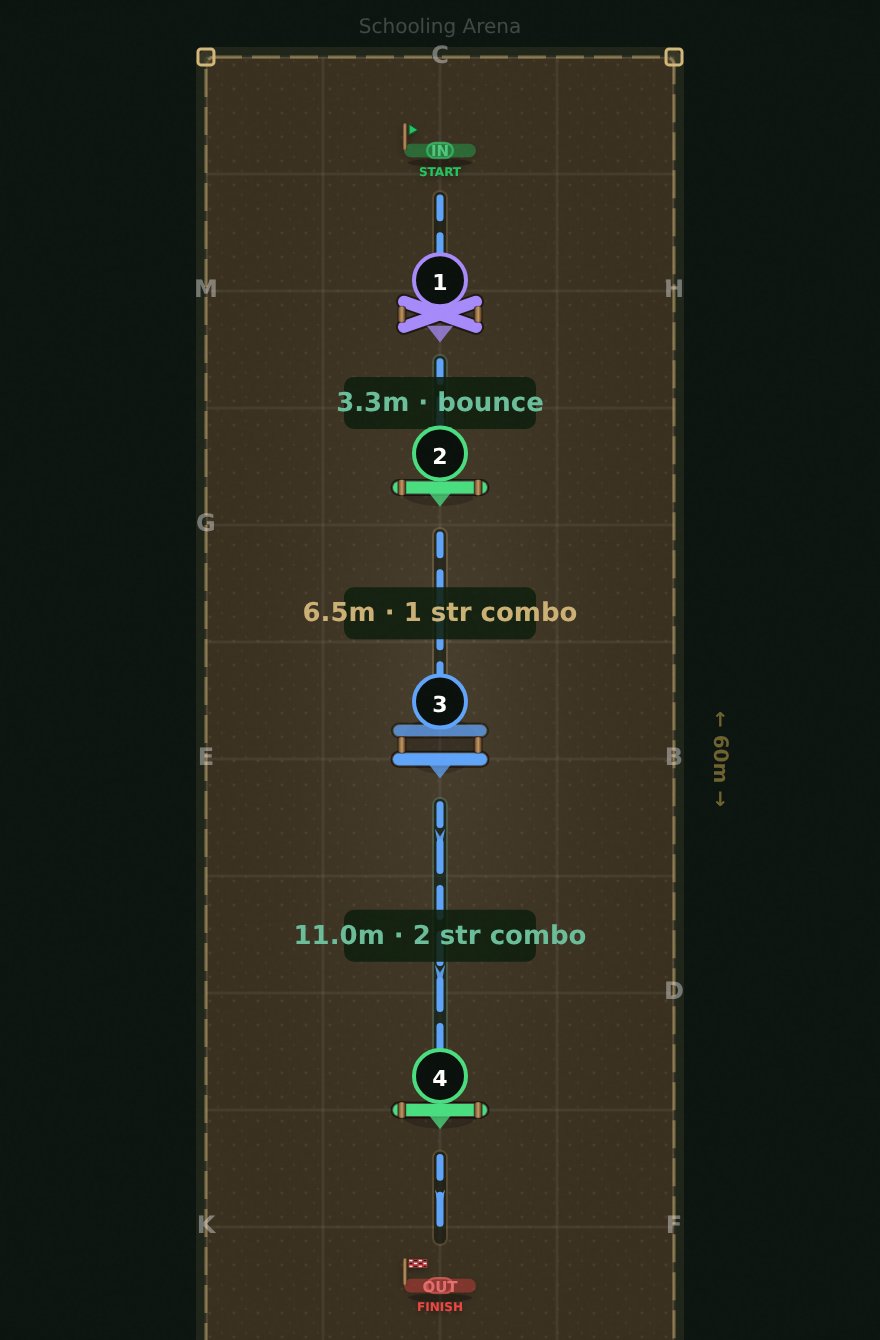
Club days go smoothly when the course is decided before the first cup goes in, not while the 70 cm class is already warming up. This checklist is aimed at UK riding club, Pony Club, and unaffiliated organisers who build their own tracks. Treat it as a planning aid. Official British Showjumping, BE, PC, or venue rules always come first.
The night before
Paper and people
- [ ] Class list with heights, speed if timed, and whether doubles/combinations are allowed
- [ ] Named course builder and one runner who can move wings
- [ ] Judge / timekeeper briefed on start, finish, and timed / not timed
- [ ] Collecting-ring steward knows in-gate and out-gate flow
- [ ] Printed course plan (or tablet with the plan locked) for judge + builder
Kit
- [ ] Enough wings, poles, fillers, numbers, and cups for the tallest class
- [ ] Tape or measuring wheel; marker for related distances
- [ ] Spare pole and cup; cable ties or tape for numbers
- [ ] Breakaway / safety kit if your venue requires it for certain fences
Morning: arena before poles
- [ ] Walk the surface, deep patches, wet corners, shiny spots under windows
- [ ] Note permanent hazards: mirrors, doors, judges’ box, PA speakers, flower tubs
- [ ] Confirm arena size (20×40, 20×60, outdoor) and mark centre line if you use one
- [ ] Clear the collecting ring of parked jumps that block the gate
- [ ] Check light for the time the main classes will run
Design order that actually works
Do not start by planting fence 1 “somewhere nice”. Work in this order:
- Fix start and finish relative to the judge and the gate.
- Place the main related distances (the lines that define the track).
- Place combinations with fair approaches.
- Fill singles to join the track without cramming every gap.
- Number last, once the path is stable.
- Walk and adjust before anyone jumps.
Drawing the plan first, on paper or in a browser designer, stops you discovering at fence 9 that there is no room for a sensible four-stride. You can sketch free on YardForge’s designer, set heights, and check planned strides before the lorry is unloaded.
Height and distance checks
- [ ] Heights match the class sheet (and pony height tables if needed)
- [ ] Oxers: front and back rail heights intentional, not accidental
- [ ] Related distances measured for this height, not copied from an open-class diagram
- [ ] Combination distances suitable for the level (no championship two-stride for 60 cm)
- [ ] No trap distance off a bad turn into a Liverpool or filler-heavy fence
Flow and welfare
- [ ] First fence inviting, not a technical test
- [ ] At least one place to rebalance between questions
- [ ] Last fence does not dump riders into the out-gate traffic
- [ ] No long run at a skinny straight after a hard rollback for the lowest class
- [ ] Water / liverpool only if the level and warm-up support it
Numbers and paperwork
- [ ] Numbers readable from the collecting ring where possible
- [ ] Start and finish markers clear
- [ ] Plan shows fence type and height
- [ ] Related distances noted on the plan for the builder
- [ ] Change log if you alter the track between classes (time, who approved)
Between classes
When you raise a track from 70 to 90 cm:
- [ ] Re-check related distances, do not only raise cups
- [ ] Re-walk combinations
- [ ] Update the printed plan or annotate clearly
- [ ] Tell the judge the track has changed
- [ ] Reset any numbers that moved with wings
Fifteen-minute walk before the first horse
Walk as a rider, not as a builder. Count strides out loud on the related lines. Stand at each combination and look at the approach. If something feels mean for the height, change it now. A five-minute move is cheaper than a class full of stops.
After the day
- [ ] Note what rode short or long (surface + height)
- [ ] Photograph the final plan for next time
- [ ] Return numbers and cups to the kit list
- [ ] Send yourself one sentence of feedback: what to never repeat
Why a digital sketch helps on club budgets
You do not need a championship CAD suite to avoid bad distances. You need a clear plan, measured lines, and a record of what you built. A free browser designer is enough to test layouts on a phone while the arena is still empty, then print for the judge.
Open the designer when you plan next week’s club day: https://yardforge.co.uk/designer.
If a line still rode oddly after you measured twice, tell us the arena size and height, that kind of feedback is useful. This checklist is practical guidance only; your governing body and show schedule remain the authority on the day.

