Show Jumping Course Design Mistakes Beginners Still Make
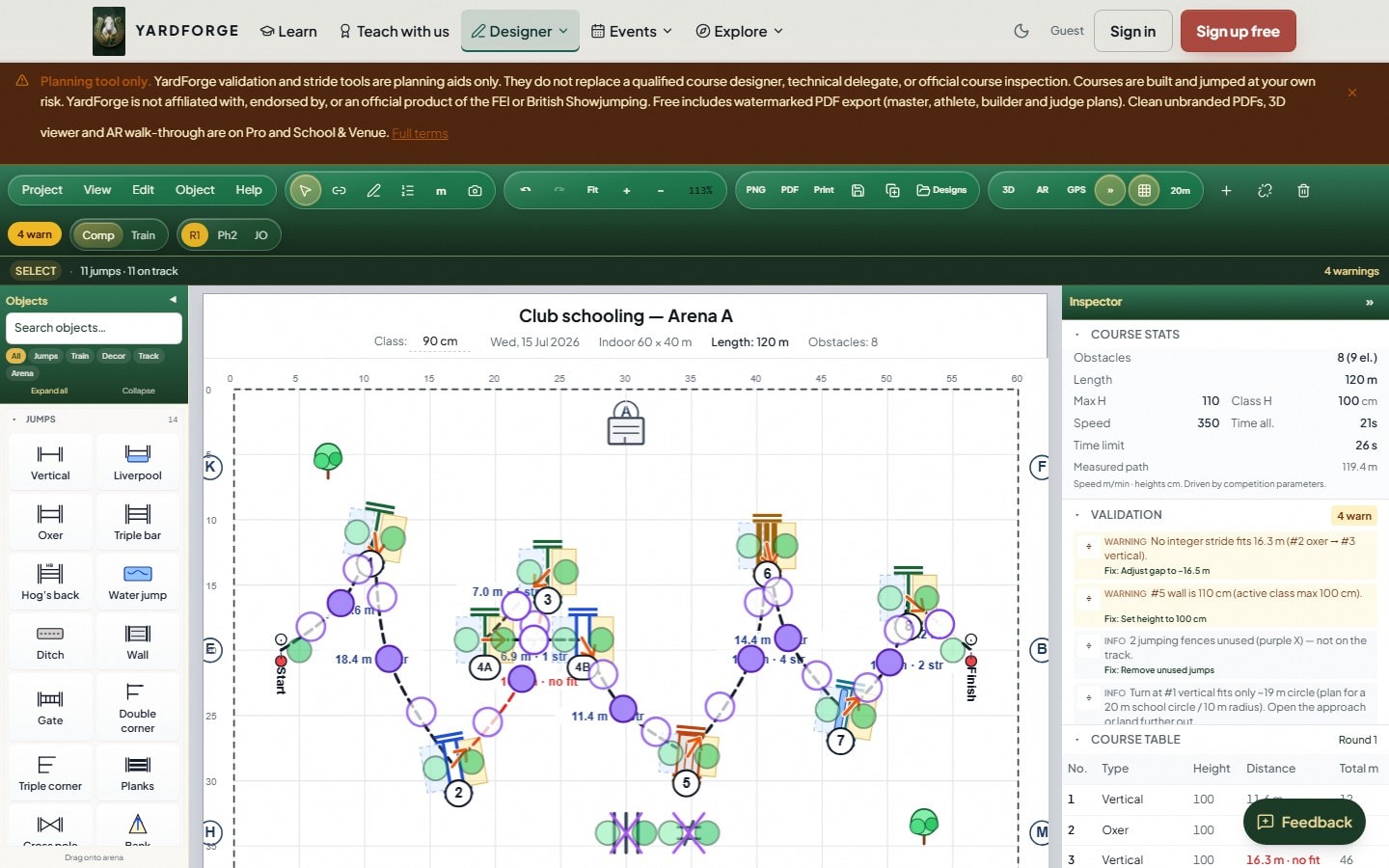
Most first courses look tidy on paper and feel awkward on a horse. That is normal. The usual problem is not missing a fancy fence, it is a handful of basic errors that stack: a short first distance, a turn that never quite gets straight, a number that confuses the collecting ring, or a combination built for a different height class than the one on the start list.
This guide is for club builders, Pony Club DCs, and coaches putting up a track at home or at a small show. It is a planning aid, not a substitute for British Showjumping, FEI, or your organiser’s rule book. Always check the current schedule and class sheet.
1. Starting the first fence too close to the in-gate
Riders need a few strides to settle after the bell. If fence 1 sits immediately off the collecting-ring entrance, green horses rush, experienced ones cut, and the steward ends up shouting. Leave room to canter in, and leave a clear path out after the last. On a 20 × 40, that often means putting fence 1 on a long side, not jammed against the short end by the gate.
Quick check: walk from the in-gate to fence 1 at a normal canter rhythm. If you feel hurried before you even jump, move the fence.
2. Treating every related distance as “four strides for everyone”
Related distances are measured for a target height and a typical stride. A four-stride line that rides beautifully at 1.10 m can feel deep or long at 70 cm. Beginners often copy a championship diagram without adjusting for height, pony classes, or a short-striding schoolmaster.
Build the distance for the class in front of you. Note pony tables separately if 128 / 138 / 148 are on the same day. If you are unsure, open the track in a designer with stride checks, print the plan, and walk it with a tape before you sink cups.
Try the free designer: yardforge.co.uk/designer, put the line down, set the height, and see the planned strides before you commit poles.
3. Combinations that only work for one lead
A double off a tight left turn that lands riders on the wrong lead for the next line will produce stops that look like “horse problems” and are really geometry. Combinations need a fair approach, a fair exit, and a next fence that does not punish a single honest mistake.
Walk the approach twice, once imagining a bold horse, once a careful one. If only the bold horse can make the turn to the out, open the corner or move the following fence.
4. Numbering that fights the collecting ring
Numbers are not decoration. A course that snakes so fence 6 is closer to the out-gate than fence 12 will snarl warm-up traffic when people walk. Keep the walk route sensible, keep numbers large enough to read from a distance, and keep the start and finish obvious for judges and timekeepers.
If you reuse numbers from last week’s track, wipe the old stickers. Half the confusion on club days is leftover 8s stuck to a wing that is now fence 3.
5. Filling every empty metre with a jump
Empty space is part of the design. Riders need room to rebalance, correct a lead, and see the next fence. A 12-fence track in a small indoor with no breathing room rides harder than a 10-fence track with honest lines. Fewer, clearer questions usually produce better jumping and fewer refusals.
6. Ignoring the ground and the light
A related distance that works on perfect fibre may ride short on deep sand after rain. Afternoon sun in a west-facing school can silhouette a Liverpool so horses do not read the back rail. Walk the course at the time of day the class will run. Move a fence a metre if the light or footing makes the question unfair.
7. No printed plan for the judge, builder, and steward
“I will remember it” fails the moment someone moves a wing. Print a simple plan: fence numbers, type (vertical / oxer), height for the class, and measured distances on the related lines. Keep one copy on the judges’ box and one with the builder. Digital plans you can tweak on a phone help when the day runs long and a class height changes.
A short pre-show checklist
- Height and speed for this class, not last month’s open.
- First fence approach and last fence exit clear of the gate.
- Every related distance walked and marked.
- Combinations have fair in and out.
- Numbers match the drawn plan.
- Printed plan with the judge.
- Warm-up fences do not block the in-gate.
Practice without wasting a lorry load of poles
Sketch the track first. Adjust strides on screen. Print. Then build. That order saves the “we measured it three times and it still rides long” afternoon.
If you want a quiet place to try that loop, use the YardForge course designer, export or screenshot a plan, and walk it against a tape in your own school: https://yardforge.co.uk/designer.
Questions or something that rode oddly at your last show? Tell us what height and arena size you were in, honest feedback is how the tool gets better. Planning aid only; your rule book and TD still win arguments on the day.

