Konickx in Tokyo next week. Team day at 1.45 m
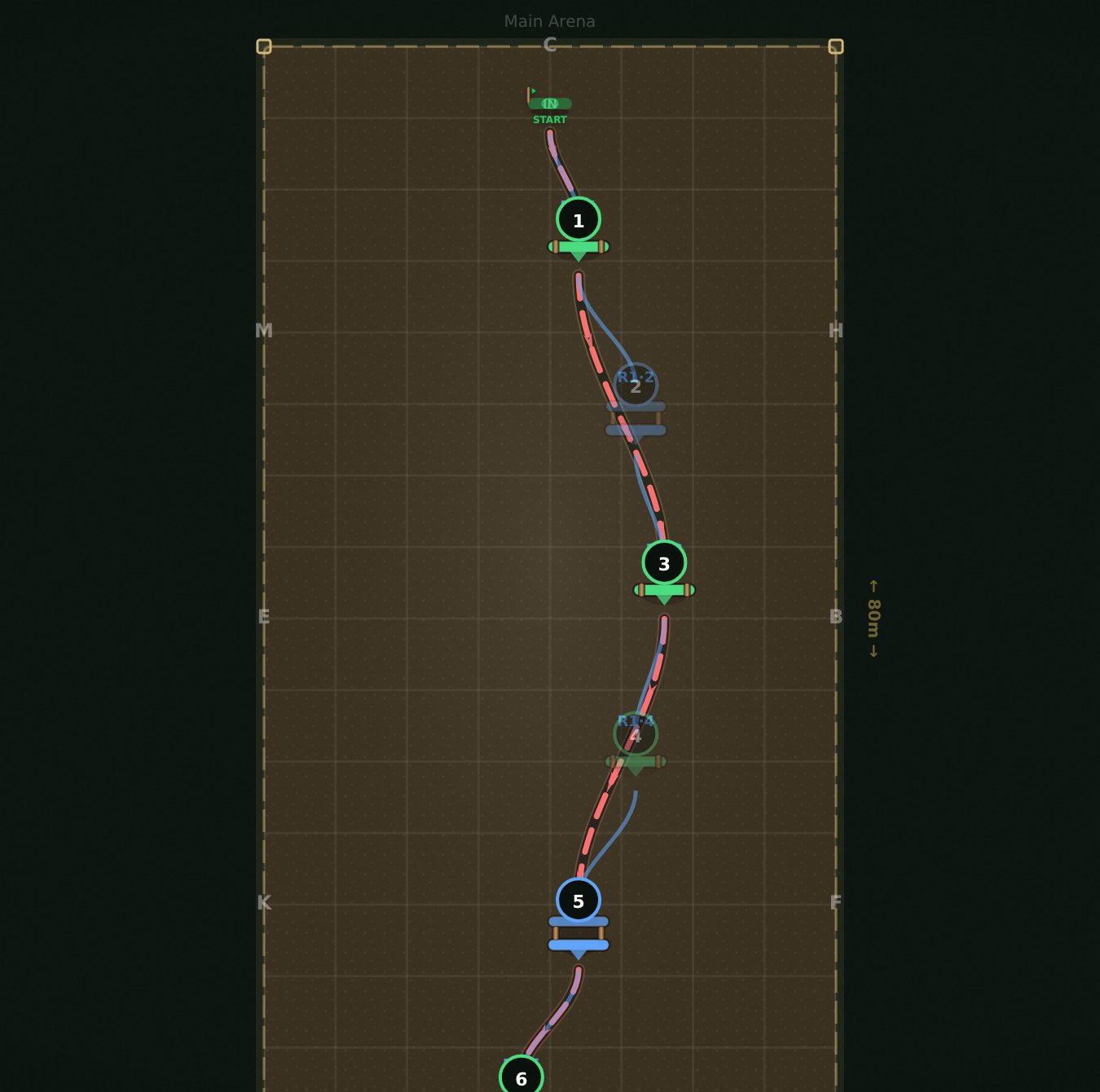
Eventing at the 20th Asian Games finished on Wednesday. Dressage is in the ring at JRA Equestrian Park this weekend. Jumping starts Thursday 1 October, still in Tokyo, not in Aichi-Nagoya. Louis Konickx (NED) is the course designer. Samir Aljuaid (KSA) assists. John Vallance (AUS) is the jumping technical delegate. That list is on the FEI appointed officials PDF, still linked from the Games page.
The sport technical handbook (version 4.1, August 2026) is the card you design to. Do not lift heights from Aachen.
Two rounds, one team height
Team jumping is one day, two rounds, Table A. Round one is not against the clock, with a time allowed. Round two is against the clock, on a different course. Both rounds are up to 1.45 m. Both are 15 efforts, 450 to 650 metres, at 400 m per minute.
That is a championship team test at a height most UK Area horses have seen. If you write a club or Area team final, copy the skeleton: same height both rounds, a speed you measured, 15 efforts if the arena can take them, and a second course that is not a reprint of the first.
Teams are three or four combinations plus one reserve horse. One substitution, veterinary reasons only, not later than two hours before round one. Teams eliminated in round one stay out. Ranking uses the best three scores each round. A jump-off for first, if needed, is one rider per team, against the clock, up to seven obstacles, still 400 m per minute.
The handbook timetable puts round one 09:30 to 12:05 and round two 13:05 to 16:05 on 1 October, with a team victory ceremony that afternoon. Friday 2 October is empty. Timings can move after entries.
Then they split the individuals
Saturday 3 October and Sunday 4 October are not one more 1.45 m class. There are two individual competitions, and an athlete may not ride both.
Individual A: first round up to 1.45 m, 15 efforts; second round up to 1.50 m, 12 to 15 efforts. Individual B: both rounds up to 1.55 m, first round 15 efforts, second 12 to 15. Both competitions are Table A, two rounds against the clock, different courses, 450 to 650 metres, 400 m per minute. The best 20 after round one go through, with a maximum of two athletes per team. Jump-off for first: up to seven obstacles.
Competition B needed a Certificate of Capability by 22 June 2026. The MER is a CSI2 1.45 m Table A on four penalties or less, and a CSI3 1.50 m Table A on eight or less, at two different outdoor events. Combinations that already jumped a World Championship, World Cup Final or Olympic Games in that window are not held to that MER. Jumping horses must be eight. Athletes must be 18 in the year of the Games.
If your Area championship has a mixed field, do not force every horse over the same second-round height. Write a team height the whole squad can jump, then a higher individual with a published qualifier. Put both tracks on one plan so the collecting ring still works. See numbering without wrecking the collecting ring.
Draw Thursday before you watch it
The Japanese national list names Takahiro Omachi as a jumping course designer, with Tatsuya Murata, Tatsuhiko Yamagishi, Yuya Kimura and Peter Grant (CAN) as assistants. Konickx is the FEI name on the championship. Watch who walks the track on Thursday.
The 2026 FEI Jumping Rules still apply. This handbook is the overlay: heights, efforts, speed, and the two-individual split.
Open the handbook PDF, print the jumping pages, and draw Thursday's team card in the designer at 1.45 m, 15 efforts, 400 m per minute, two different rounds. Then watch 1 October. If you only have Sunday, the 1.55 m second round is listed at 14:10 local. The League of Nations Final in Barcelona is the same calendar day. Pick one stream and sit down with a pencil.

