How to Measure Show Jumping Related Distances Without a Measuring Wheel
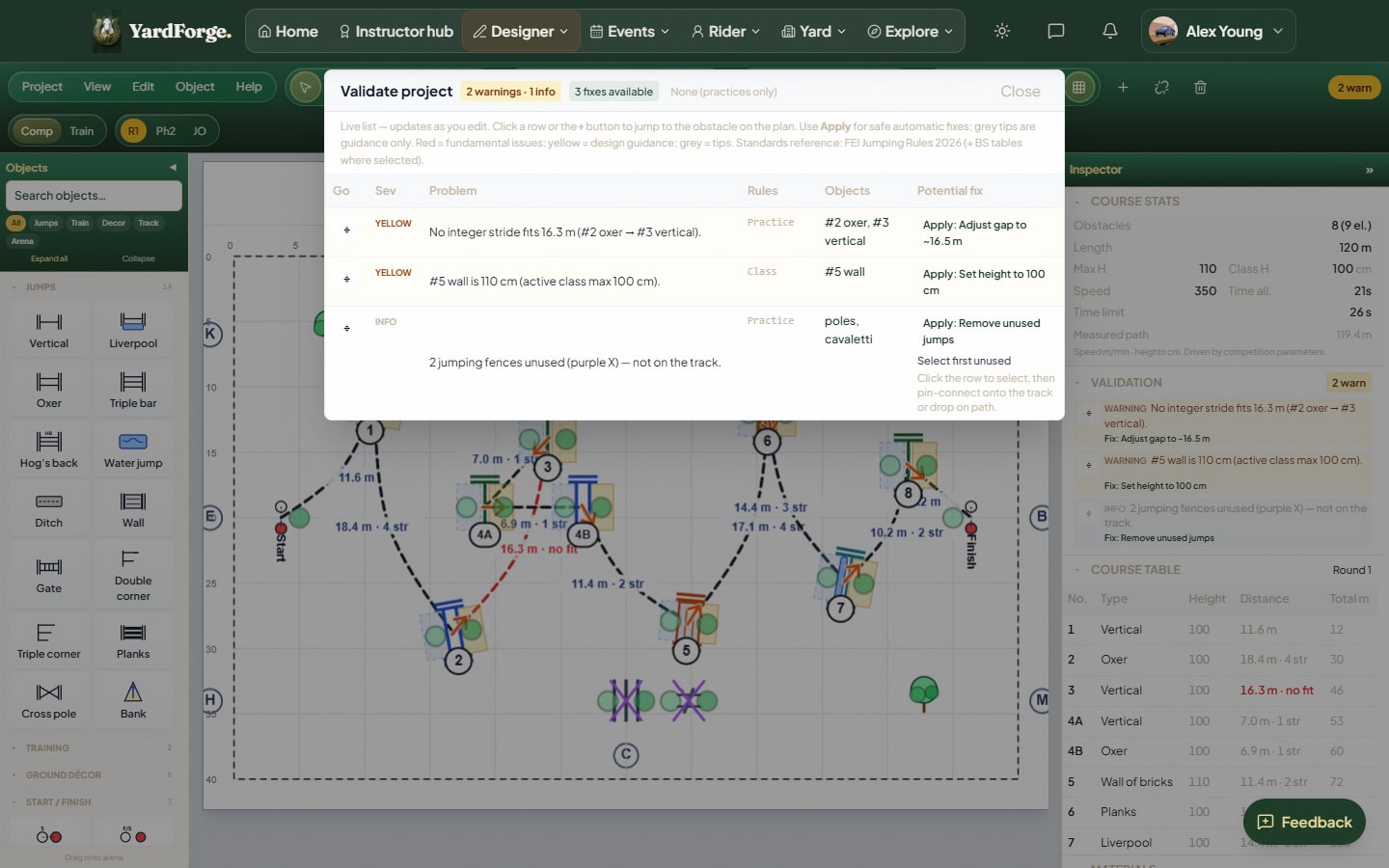
Plenty of club arenas have poles and wings but no measuring wheel. You can still set honest related distances with a long tape, a bit of method, and a plan you trust. This is everyday building practice for UK schools and paddocks, a planning aid, not a replacement for your rule book or technical delegate.
What you are actually measuring
For a related distance you care about the distance between the two fences on the line the horse jumps, usually taken from the centre of the first fence to the centre of the second (or the landing side to the take-off side, depending on how your trainer was taught, pick one method and stay consistent all day).
That distance has to match the number of strides you want at the height of the class. A four-stride line is not a universal number of metres for every horse and every height.
Method 1: Long tape (best when you have one)
- Place both fences roughly where you want them.
- Run the tape along the line of flight, not along the arena fence unless the line is dead parallel to it.
- Measure centre to centre (or your chosen consistent points).
- Adjust the second fence until the tape reads the distance you planned.
- Walk the line in the canter rhythm you expect and confirm it feels like the stride count.
Two people make this faster: one holds at fence A, one moves fence B. If you are alone, weight the tape end with a jump cup and work carefully.
Method 2: Calibrated boot strides (when the tape is short)
If your tape is only 10 m:
- Measure your own walking pace over 10 m on flat ground (how many steps).
- Write that down, do not guess later when you are tired.
- Walk the line counting those calibrated steps.
- Convert back to metres.
- Still finish with a canter walk-through for feel.
This is less precise than a full tape but better than “it looks like four”. Recalibrate if you change boots.
Method 3: Plan first, then build to the plan
The cleanest approach when kit is limited:
- Draw the arena to scale (graph paper or a course designer on your phone).
- Place the related line and read the planned distance and strides for your height.
- Build fence A, measure out the planned gap, place fence B.
- Only then walk it.
Designing on screen does not replace measuring, it stops you inventing a distance under pressure. The free YardForge designer lets you lay a line, set a height, and see the intended stride pattern before you drag wings: https://yardforge.co.uk/designer.
Canter feel still matters
Metres get you close. Horses tell you the truth. After measuring:
- Walk the line at a steady canter rhythm (many builders jog or canter the count).
- Note deep going, distances can ride short in sand that has not been watered evenly.
- For ponies, do not assume horse distances; use the appropriate table for the class.
If the measured four-stride rides like three-and-a-half for every horse in the warm-up, move the fence. Pride is cheaper than a stop.
Common measurement mistakes
| Mistake | What happens | Fix |
|---|---|---|
| Measuring along the boards on a diagonal line | Distance too long | Measure on the jumping line |
| Mixing take-off/landing points mid-day | Inconsistent lines | One method, labelled on the plan |
| Copying a 1.20 m distance for 70 cm | Over-facing or awkward | Height-specific plan |
| Ignoring a slope | One way rides long, other short | Walk both directions if the class reverses |
| No note on the plan | Afternoon rebuild guesses | Write the metres on paper |
Indoor 20 × 40 reality
In a small indoor you often cannot fit the open-class lines you saw at a county show. That is fine. Shorter related distances and fewer fences beat cramming a championship pattern into a school that will not hold it. Measure what fits; do not force what does not.
A minimal kit list that covers 90% of club days
- 30 m tape (or 10 m + calibrated walk)
- Notebook with arena size and class heights
- Printed or phone plan with intended strides
- Chalk or tape to mark centres if wings move
Worked mini example
You want a four-stride related distance for a 90 cm club class on outdoor grass.
- Sketch two verticals on a long side.
- From your plan, note the target distance for four strides at that height.
- Place fence A.
- Tape out the distance on the line of flight; place fence B.
- Canter-count the line.
- If it rides deep for the horses you expect, add a little distance and re-check, small moves, not wild swings.
Keep a record
Write the final measured distance on the course plan. Next time the same arena rides similarly, you start ahead. Photos of the plan help when the same club builds monthly.
If you want to test lines before you unload the trailer, sketch them in the designer and take the numbers to the arena: https://yardforge.co.uk/designer.
Measured carefully, walked honestly, adjusted without ego, that is most of good club building. Rules and TDs still have the final word on competition day.

